
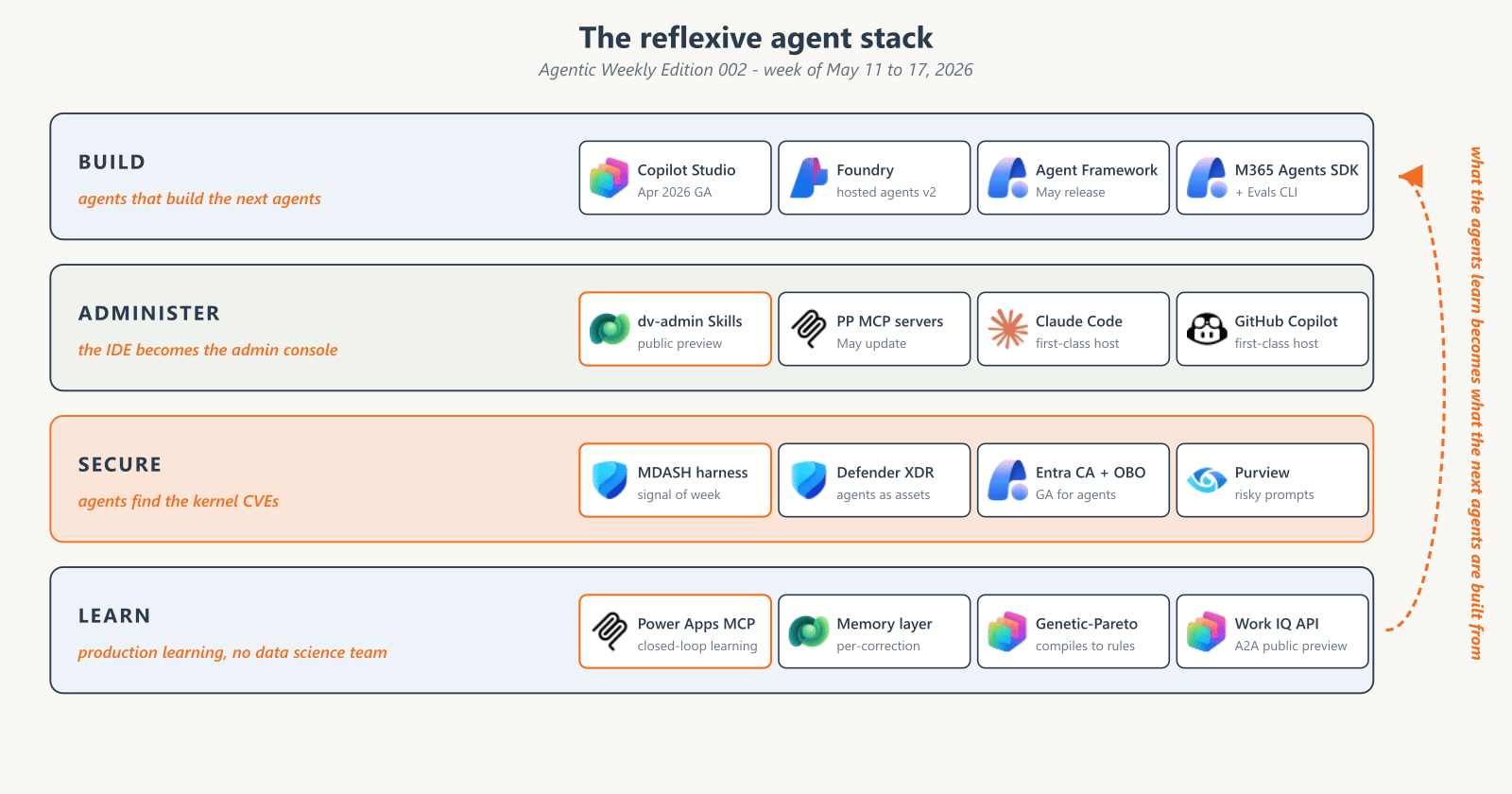
The week the agent stack got reflexive
Five product drops and one security one, all pointing the same direction. Microsoft shipped agents that find Windows zero-days, agents that learn from user corrections in production without a data science team, agents that administer Dataverse via plain English from Claude Code, agents that build canvas apps from your IDE, and the Agent 365 control plane wired straight into Copilot Studio authoring. The week the agent stack started doing agents' work on itself.
This week's thread: agents are the workforce that builds and runs the agent platform
Edition 001 argued agents went from feature to platform. This week the loop closed. Microsoft's own security org wired 100+ AI agents into a vulnerability scanner that topped the CyberGym leaderboard and shipped 4 critical RCEs into the May 12 Patch Tuesday cohort. The Power Platform team made the IDE the admin console for Dataverse, made closed-loop learning the default for Power Apps agents, turned canvas authoring into an MCP server, and pulled Agent 365 governance straight into Copilot Studio. Five months ago every one of those required a custom integration and a dedicated team. This week they shipped as platform defaults. When the platform team uses agents to build the agent platform, you are no longer early. You are late if you have not picked your stance.
Signal of the week
Microsoft's 100-agent security harness (codename MDASH) finds 16 new Windows vulnerabilities including 4 critical RCEs
@Taesoo Kim's team published research on May 12 showing MDASH (Microsoft Defender Agentic Scanning Harness), an ensemble of 100+ specialized AI agents across frontier and distilled models that discover, debate, and prove exploitable bugs end-to-end. Results: 21 of 21 planted vulnerabilities found with zero false positives on a private test driver, 96% recall against 5 years of MSRC cases in clfs.sys, 100% in tcpip.sys, and an industry-leading 88.45% on the public CyberGym benchmark (top of the leaderboard, ~5 points ahead of the next entry). The harness contributed CVE-2026-33827 (remote unauthenticated UAF in tcpip.sys via SSRR) and CVE-2026-33824 (unauthenticated IKEv2 SA_INIT fragmentation double-free to LocalSystem RCE) into the 5.12.2026 Patch Tuesday cohort. Limited private preview now open.
Why it matters
Two things matter for your customers. First, agent-stack RCE discovery has crossed from research demo to production vuln-pipeline contributing into Patch Tuesday. The next conversation with your customer's CISO about 'who is hunting our agent code' has a Microsoft-first answer. Second, the architectural lesson generalizes: 'the durable advantage lies in the agentic system around the model rather than any single model itself.' This applies one-for-one to the Copilot Studio agent you are scoping next quarter. If your design assumes the model picks up the slack, you are betting against the team that just put 100 agents into the kernel hunt.
1Copilot Studio
April 2026 update lands - Agent 365 governance wires into Copilot Studio authoring, Analytics Viewer GA, usage estimator covers D365 agents
@Nitasha Chopra's May 11 post shipped three Copilot Studio things at once. Agent status (security posture, auth gaps, policy impacts) now surfaces directly in the authoring experience, with one-click investigation. The Analytics Viewer role is generally available, giving stakeholders read-only access to an agent's Analytics page without the right to modify it. The expanded agent usage estimator now forecasts Copilot credit consumption across Copilot Studio AND Dynamics 365 agents (Sales Qualification Agent, Customer Service Agent) in a single view. Most consequential: Agent 365 GA is now integrated into Copilot Studio, so the agents you build are governed alongside M365 agents and partner-built agents through one control plane.
Why it matters
The split-brain era of 'I build in Copilot Studio but govern somewhere else' is over. The Analytics Viewer role fixes a long-standing customer complaint - operational visibility without publishing rights - which means business stakeholders can finally watch agents in production without you giving away keys to the kingdom. For Dynamics customers, the unified usage estimator is the first time you can build a credible TCO for an agent estate that spans both runtimes.
- QuickWork IQ API public preview also dropped this week with Agent-to-Agent (A2A) protocol access; standard request/response surface lands later in May for apps that don't need streaming. The piece that turns Work IQ from 'Cowork's internal brain' into a building block other agents can call.
2Power Apps + Power Platform
Closed-loop learning ships on the Power Apps MCP server - production-grade agent learning without a data science team
@Srihari Srinivasa's May 12 post introduced closed-loop learning for agents connected to the Power Apps MCP server, starting with the data entry tool. Every user correction in the Agent feed persists as structured memory. On future runs the agent retrieves that memory and applies it. The pattern shipped has two layers: memory-based optimization (the agent learns the correction and applies it next time) and Genetic-Pareto optimization, an evolutionary technique that distills repeated corrections into rules compiled into the agent's instructions - so the principle becomes default behavior rather than a pattern the agent has to remember to look up. Both layers run in production today with no pipeline to configure.
Why it matters
This is the first commercial implementation I have seen that closes the 'why can't the agent learn how we actually use it' loop without a custom MLOps team. The example Microsoft uses (an invoice agent that learns 'UK' -> 'United Kingdom', then generalizes to 'USA' -> 'United States of America') is the exact failure mode your customers hit in week two of any document-processing agent. If you are scoping invoice, contract, or form-extraction work this quarter, this is the architectural unlock that lets you sell 'the agent gets smarter without quarterly retraining' with a straight face.
Canvas Authoring MCP Server + PowerCAT InfoPath Migration Skill - your IDE is now the Power Platform authoring surface
The May 14 Power Platform feature update introduced two new MCP server / skill pairings: a Canvas Authoring MCP server lets makers build and modify canvas apps from Claude Code, GitHub Copilot, or any MCP-compatible coding agent. The PowerCAT Skill for InfoPath Migration uses the same path to automate the long-standing 'migrate this 15-year-old InfoPath form to a modern Power App' workload. Companion updates: Power Fx user-defined types are GA, generative pages can now take input from command bar buttons / grid row actions / subgrid navigations (no longer top-level only), and custom MCP-powered tools with Fluent-based UI widgets are in public preview for app-based conversations in M365 Copilot.
Why it matters
Two things. First, the 'make studio' is no longer one canonical UI - it is an MCP API your team can drive from whatever coding agent they prefer. If your maker team is split between GitHub Copilot loyalists and Claude Code adopters, you don't have to pick. Second, the InfoPath migration skill is the unlock that suddenly makes a pile of clients' five-figure InfoPath sunset projects tractable in a single sprint. Worth a proactive call to any customer still on SharePoint InfoPath forms.
- QuickPublic preview: custom tools and rich Fluent UI for app-based conversations - lets model-driven apps push interactive widgets into Copilot, not just data, via the app's MCP server and declarative agent.
- QuickGenerative pages now display in the Power Apps mobile app (offline still pending), and the 'add a page' flyout finally lets you reuse an existing generative page across multiple apps.
3Dataverse
Dataverse Admin Skills (dv-admin) go public preview - manage 50 environments with natural language from Claude Code or GitHub Copilot
@Anirudha Bakore's May 12 post introduced Dataverse Admin Skills, a plugin that ships under the Dataverse Skills umbrella (dv-admin, dv-data, dv-query, dv-metadata, dv-solution). Admins describe what they want in plain English inside Claude Code or GitHub Copilot; the plugin translates intent into PAC CLI commands (pac org, pac data, pac admin, pac auth), executes against the Dataverse Web API, and handles org settings, OrgDB toggles, bulk delete, retention, recycle bin, and security. The agentic path enforces a 37-toggle PPAC allowlist and built-in safety guardrails: confirmation prompts before destructive operations, FetchXML validation, system table warnings, multi-environment parallel execution. Example prompt: 'Enable AllowMCP setting on all environments starting with Preprod' - the agent lists matching environments, asks for confirmation, updates each in parallel, and returns a summary table.
Why it matters
If you spend any meaningful percentage of your week clicking through the Power Platform admin center across 20+ environments, this is the biggest single change to your day-to-day in three years. But the more important Microsoft signal is the choice of distribution channel: dv-admin ships into Claude Code and GitHub Copilot. The Power Platform admin console of 2027 is your IDE. If you are scoping a CoE engagement, the admin tooling deliverable just shifted from 'PPAC training' to 'IDE setup + skill onboarding'. The skill list also gives the rest of the Dataverse plugin family (dv-data, dv-query, etc.) production cover - expect those to leave preview faster than usual.
- QuickCapacity Management (storage breakdowns, growth trends, capacity alerts, archival recommendations) is the next dv-admin scope on the roadmap - the missing piece for admins managing tenant-level Dataverse costs.
4Multi-agent + A2A
Work IQ API public preview - cross-vendor agent access via A2A and a standard REST surface coming this month
The Copilot Studio team published the Work IQ API public preview, exposing Work IQ intelligence (the people / topics / signals graph that powers Copilot Cowork) through two paths. Agent-to-Agent (A2A) is live now, letting agents from other vendors query Work IQ as a tool inside multi-agent orchestrations. A standard request/response REST surface (no streaming, no A2A coordination required) is scheduled for later in May for applications that just need a query/answer round-trip. The same post details how to build Copilot-powered agents that consume Work IQ alongside other A2A-compatible agents.
Why it matters
Work IQ has been Cowork's internal brain since the May 5 launch. Opening it via A2A makes it a first-class building block for the multi-agent stacks you're now scoping for customers. Combined with last week's confirmation that Copilot Studio agents speak A2A cross-vendor, a meaningful set of non-Microsoft agents (LangGraph, AutoGen, Mistral-built, Anthropic-built) can now ground answers in your customer's Work IQ graph through one protocol. The architecture conversation shifts again: 'which of our existing tools should be A2A endpoints' becomes a real planning question, not a 2027 hypothetical.
Voices to follow
- Copilot Studio MVPLisa Crosbie
6x Microsoft MVP, Practical AI for Business with Copilot and Agents at Barhead. Her 'Build and Use Agents in M365 Copilot' complete tutorial cleared 59K views. Calm, hands-on voice on agent design - the one to follow for production-grade Copilot Studio patterns.
6x Microsoft MVP - YouTuber + International Speaker - ~21K followers - Microsoft PM, Power PlatformReza Dorrani
Principal Program Manager at Microsoft in the Power Platform CAT team. Currently posting hands-on Power Apps + Dataverse MCP demos that map exactly onto this edition's signals. Where the maker community goes to see new features in action.
Microsoft Principal PM - ~56K followers - Power Platform MVPShane Young
20-year Microsoft MVP, PowerApps911 founder, 182K YouTube subscribers. Microsoft-paid collaborator on the official Copilot Studio for Power Platform Makers series. Just published 'State of Power Platform & Copilot in 2026' from 380 real practitioner responses.
Power Apps + Copilot Studio MVP - ~46K LinkedIn / 182K YouTube - Microsoft Power Platform AdvocateApril Dunnam
Power Platform Advocacy team's loudest voice on Copilot Studio. 'Sample of the Week' series, PPCC 2026 keynote slot, Demystifier role. If a CS feature ships and April hasn't posted about it within 48 hours, it didn't happen.
Microsoft Senior Cloud Advocate - Power Platform + AI Demystifier - Microsoft Cloud Advocate (formerly MVP)Daniel Laskewitz
Principal Cloud Advocate at Microsoft, formerly Power Platform MVP and co-founder of Forward Forever. Deep multi-agent + Power Platform governance commentary. The bridge between the maker community and the M365 + Power Platform PnP team.
Microsoft Principal Cloud Advocate - Power Platform governance + agents - Microsoft - the person who built CoworkBas Brekelmans
Software Engineer at Microsoft, started the Copilot Cowork project and previously CTO of Copilot Studio. Brought Anthropic Sonnet 4 and Opus 4.1 into M365 Copilot and Copilot Studio. The clearest voice on why Microsoft chose multi-model + MCP + cloud-only architecture for Cowork.
Microsoft Software Engineer, Cowork - ex-CTO Copilot Studio - Copilot Studio MVPMikko Koskinen
AI & Copilot Lead at Forward Forever (the Finnish consultancy Daniel Laskewitz co-founded before joining Microsoft). 20+ years in the Microsoft ecosystem, hands-on Copilot Studio + Copilot Agents + Power Platform architect. Active speaker on agent-based solutions with a strong governance lens - the right voice if you're scoping CS at enterprise scale.
Microsoft MVP Copilot Studio - AI & Copilot Lead at Forward Forever - Copilot Studio MVP + MCTBülent Altinsoy
Senior Expert in Power Platform + Copilot Studio at Avanade Germany (15+ years), Microsoft MVP since 2025, MCT since 2021. Host of the 'Copilot Inside' podcast and 'That Aloha (Saying) Guy' Substack. The voice that makes Copilot Studio fun to learn - and the one to follow for hands-on agent-testing patterns with the Copilot Studio Kit.
Microsoft MVP Copilot Studio - MCT - Avanade Germany - podcast host
Coming up
- Wednesday May 13, 8am PT · Mike Tholfsen hands-on webinar: Study & Learn agent in M365 Copilot, agent goes globally available for all students 13+ and educators alongside the session.
- June 1, 2026 · GitHub Copilot moves to usage-based billing, with updated model multipliers for PRUs.
- June 2-3, 2026 · Microsoft Build 2026, San Francisco + online. Expect Build to land the next wave of MCP server announcements, Foundry hosted-agent updates, and the formal positioning of MDASH for customers.
- July 2026 · Copilot Cowork general availability.
- August 2026 · EU AI Act enforcement begins for high-risk AI systems. Three months out. Most clients still have not run their classification audit.
This week's question
If Microsoft's security org now ships agents that contribute kernel CVEs, and the Power Platform team ships closed-loop learning, natural-language admin, and MCP-everywhere authoring as defaults, the platform team has effectively told you 'you should be doing the same thing.' Which part of your delivery do you still do by hand because you have not yet found the right agent to do it with you?
Get Agentic Weekly in your inbox
Every Monday morning. Unsubscribe any time.