
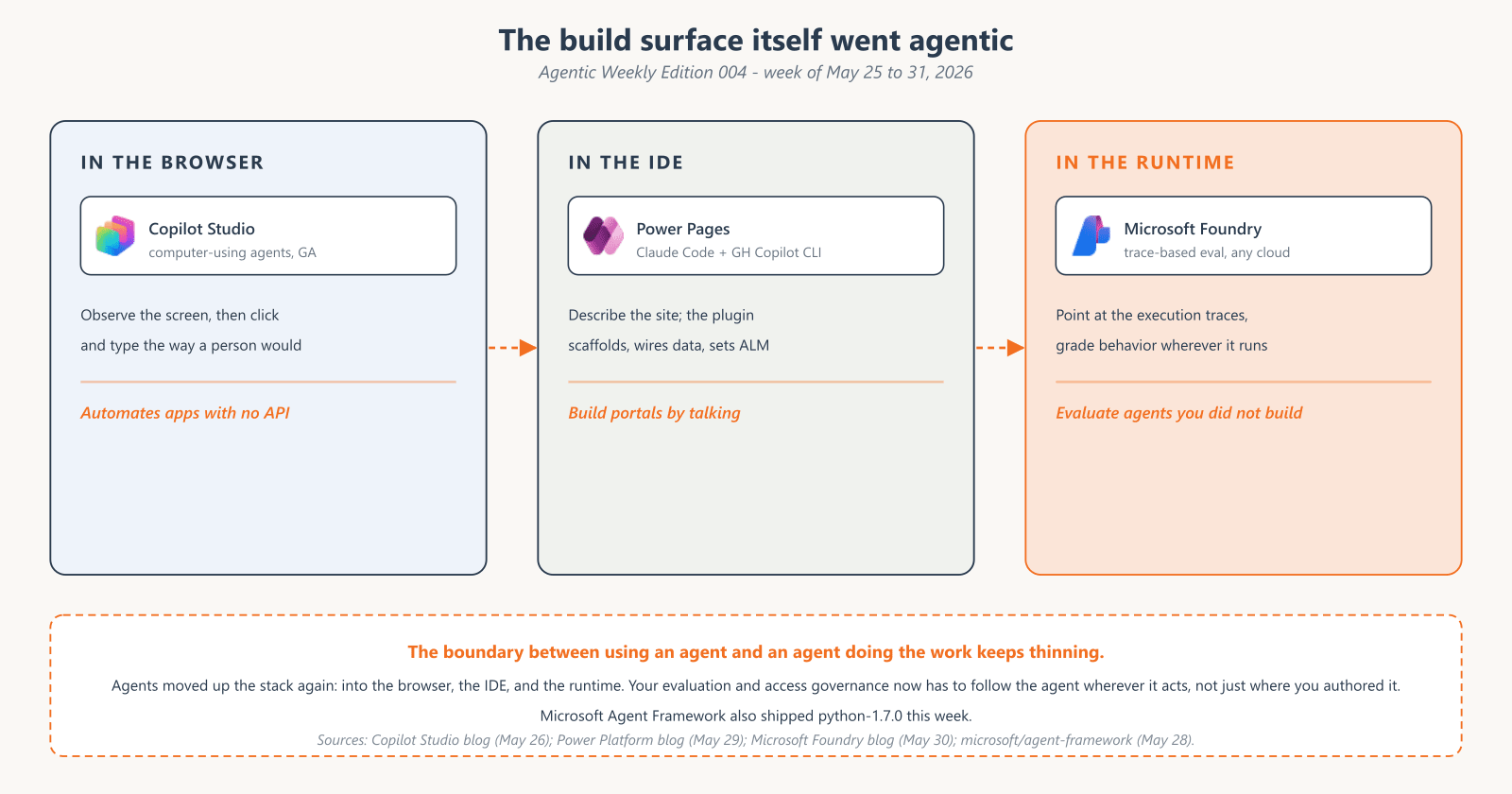
The week the build surface itself went agentic
This week the tools you use to build agents started acting like agents. Computer-using agents reached general availability in Copilot Studio, so an agent can now operate an app through its screen when there is no API to call. Power Pages site-building moved inside Claude Code and the GitHub Copilot CLI, so you scaffold a portal by talking to a coding agent. Foundry extended trace-based evaluation to any agent on any cloud, so you can now grade agents you did not build in Foundry. And the Microsoft Agent Framework shipped python-1.7.0. The build loop is closing.
This week's thread: the agent-building surface is becoming agentic itself
Edition 003 was about capability and its controls shipping together. This week the story moved up a layer: the surfaces you build on started behaving like agents. In Copilot Studio, computer-using agents reached general availability, which means an agent can drive an application through its user interface, clicking and typing the way a person would, for the long tail of systems that never exposed an API. In Power Platform, building a Power Pages site is now something you do by talking to a coding agent in Claude Code or the GitHub Copilot CLI, with the plugin scaffolding the site, wiring Dataverse and the Web API, hardening security, and setting up ALM pipelines. In Foundry, trace-based evaluation expanded to any agent running on any cloud, so the eval surface is no longer limited to agents authored inside Foundry. And the Microsoft Agent Framework reached python-1.7.0. Read together, the pattern is that the boundary between using an agent and an agent doing the work keeps thinning, across the browser, the IDE, and the runtime. The interesting consequence for builders is that your evaluation and governance story now has to follow the agent wherever it acts, not just where you authored it. Capability moved up the stack again. The question is whether your guardrails moved with it.
Signal of the week
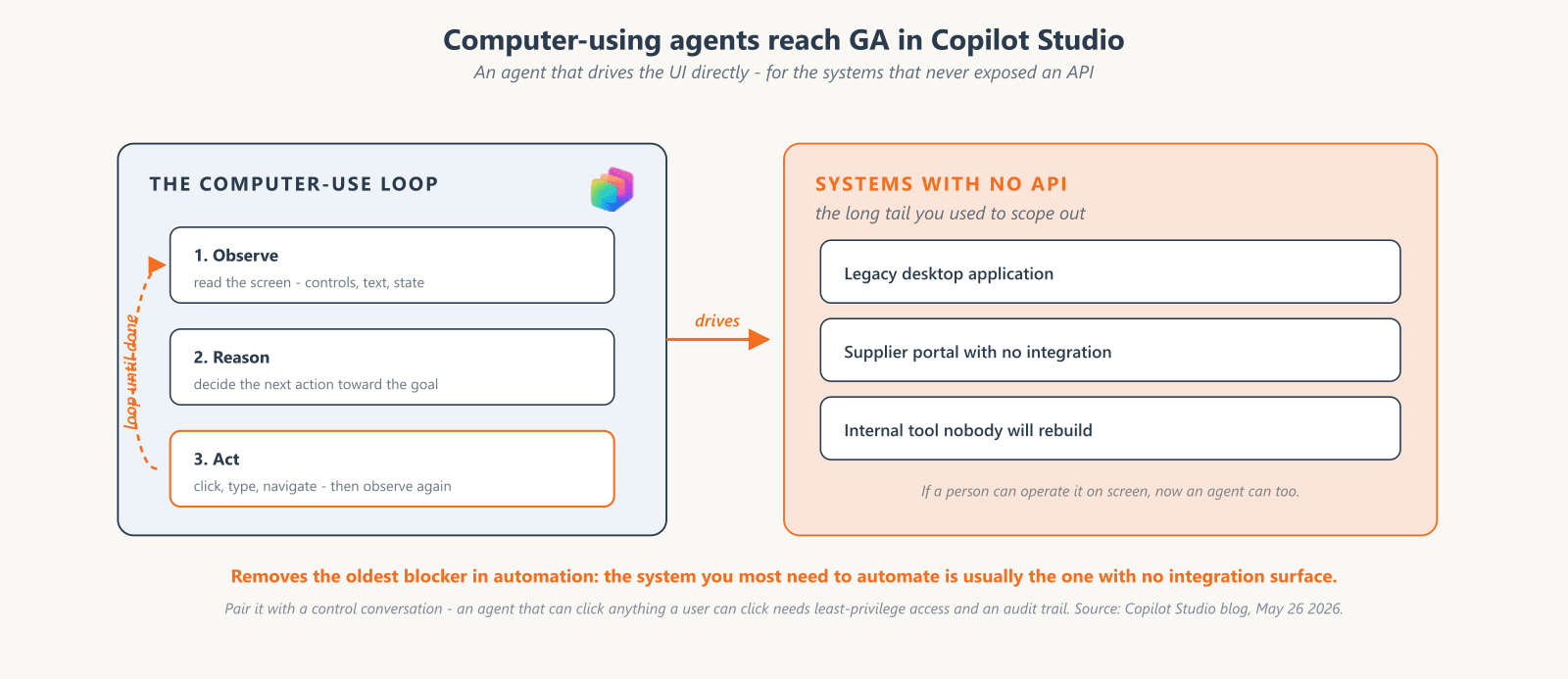
Computer-using agents reach general availability in Copilot Studio
@Nitasha Chopra's May 26 Copilot Studio update made computer use generally available, graduating it from preview. A computer-using agent operates an application the way a person does: it observes the screen, reasons about what it sees, and clicks, types, and navigates to complete a task. The point is the long tail of systems that never exposed an API or a connector. A legacy desktop app, a supplier portal with no integration, an internal tool nobody will rebuild, all become automatable by an agent that drives the UI directly. The same update shipped a redesigned workflows experience that lets you add existing agents directly into a workflow, and new real-time voice capabilities for customer-facing agents, paired with a published governance guide for managing voice agents at scale. Computer use is the headline because it removes the oldest blocker in process automation: the system you most need to automate is usually the one with no integration surface.
Why it matters
Most automation projects stall on the same wall, which is the critical system with no API. Computer use at GA means you can stop scoping that system out and start scoping it in, which changes what you can promise in a discovery workshop. It also raises the governance bar, because an agent that can click anything a user can click needs the same access discipline you would apply to a human operator, plus monitoring of what it actually did. If you run agent delivery, this is the week to add a computer-use track to your intake, with a paired control conversation about least-privilege access and auditability before the first one ships.
1Power Platform AI
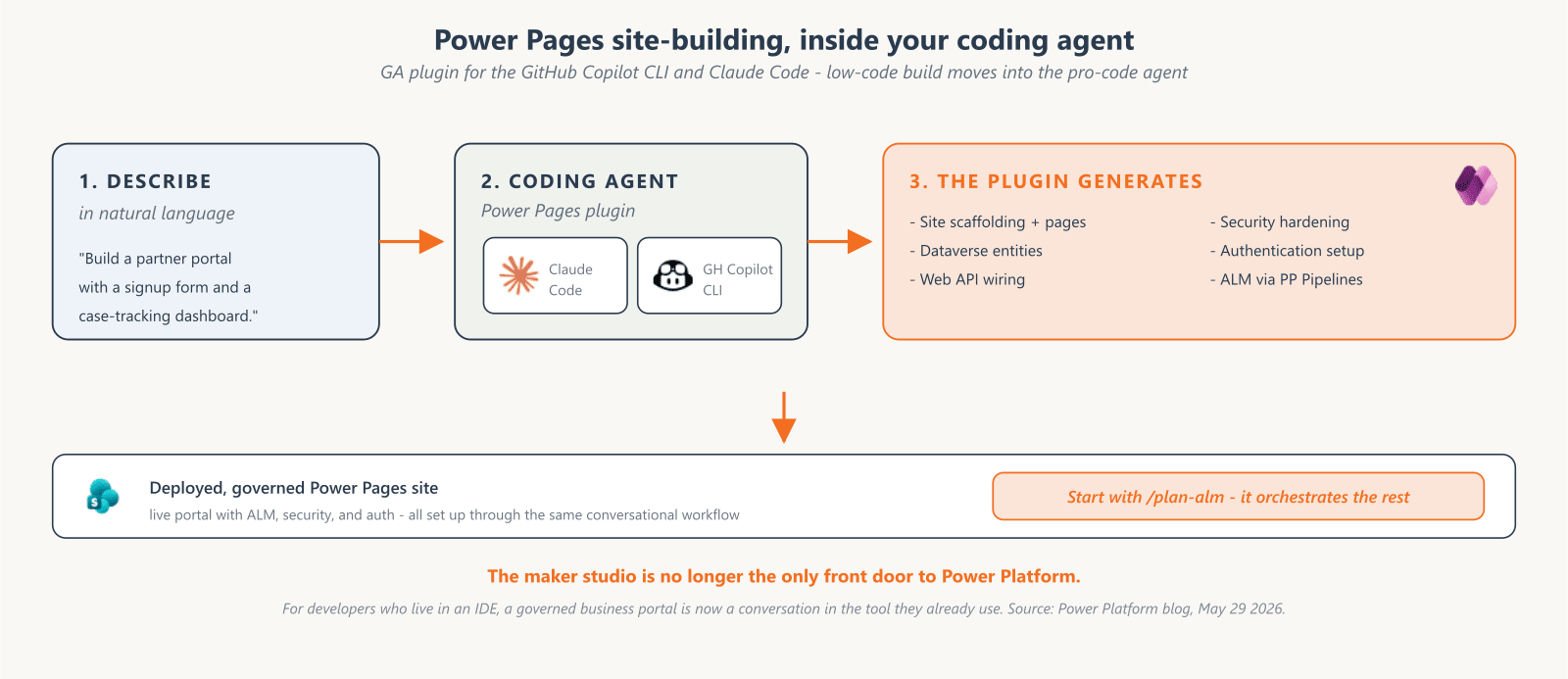
Power Pages site-building goes GA inside Claude Code and the GitHub Copilot CLI
@Neeraj Nandwana's May 29 post announced general availability of the Power Pages plugin for the GitHub Copilot CLI and Claude Code. You describe the site you want in natural language and the plugin generates the scaffolding, sets up the Dataverse entities, wires the Web API, and deploys the site, all inside the coding agent you already use. GA adds the parts that turn a demo into something shippable: Application Lifecycle Management through native Power Platform Pipelines, security hardening for the live site, and an expanded set of authentication options, all driven through the same conversational workflow. There is an orchestrator skill: start with /plan-alm if you are not sure where to begin and it runs the other skills for you. This is low-code build moving into the pro-code agent, rather than the maker portal.
Why it matters
The maker studio is no longer the only front door to Power Platform. For developers who live in an IDE, building a governed business portal is now a conversation in the same tool they use for everything else, with ALM and security included rather than bolted on after. That collapses the handoff between the pro-dev and low-code worlds that has slowed Power Pages adoption on engineering-led teams. If your developers resisted the maker experience, this is the version to put in front of them, and the /plan-alm orchestrator is the right starting point because it bakes the lifecycle in from the first prompt.
2Microsoft 365 Copilot
A new design for Microsoft 365 Copilot, cleaner and faster across the apps
On May 28 Microsoft introduced a redesigned Microsoft 365 Copilot app and a refreshed way Copilot shows up across the Microsoft 365 apps, described as cleaner, faster, and more in the flow of work. The app now runs as a single instance with smoother navigation and quicker interactions, reducing the window and context sprawl that built up as Copilot spread across surfaces. It is a design and performance pass rather than a new capability drop, focused on the everyday friction of moving between Copilot and the document, mail, or chat it is helping with.
Why it matters
Adoption lives and dies on the small friction, not the feature list. A faster, single-instance Copilot that stays in the flow of the work is the kind of change that quietly lifts daily active use, which is the metric your steering committee actually tracks. If you run a Champions program, flag the redesign before it lands so the change does not read as something broke, and use it as a prompt to refresh your in-the-flow guidance for where Copilot now appears.
- QuickThe May 2026 What's New in Microsoft 365 Copilot roundup updated the Copilot Notebooks design to organize chats and work by project, and added a prompt gallery page so users can find a starting point, try a prompt, and share workflows across the org. Both target the blank-prompt problem that stalls first-time adoption.
- QuickSame roundup: a faster GPT-5.5 variant surfaces as GPT-5.5 Quick response in the Copilot Chat model selector and rolls out to Copilot Studio early release environments as GPT-5.5 Chat. Worth a line in your which-model-when guidance alongside the Instant and Thinking split from last week.
3Foundry and frameworks
Foundry extends trace-based evaluation to any agent on any cloud
@Nick Brady's May 30 Foundry roundup led with an evaluation shift: trace-based evaluation now works for any agent on any cloud, not just agents authored inside Foundry. You point the evaluator at an agent's execution traces and grade behavior wherever the agent runs, which is the missing piece for teams operating a mixed fleet of in-house and external agents. The same drop added Grok 4.3 and DeepSeek V4 to the model catalog, moved GPT-5 Reinforcement Fine-Tuning to gated general availability, shipped three Microsoft Research on-device agent models, brought Managed VNET to GA, added project-level cost attribution, and reached GA for Content Understanding. It is a dense month, but the evaluation change is the one that alters how you operate agents you did not build.
Why it matters
Last week Microsoft published an eval-gated CI/CD pattern for Foundry-authored agents. This week the eval surface widened to agents running anywhere, which matters because real estates are mixed: some agents you built in Foundry, many you did not. Trace-based evaluation that follows the agent rather than the authoring tool is what lets you hold a consistent quality and safety bar across the whole fleet. If you are standing up agent operations, this is the hook to centralize evaluation now, before each team invents its own scoring and you lose the ability to compare.
Microsoft Agent Framework ships python-1.7.0
The Microsoft Agent Framework released python-1.7.0 on May 28, the latest in its steady cadence of Python releases. The changelog continues the framework's push toward production-grade declarative workflows and end-to-end agent samples, including fixes to workflow control flow such as foreach body exit wiring, and additions to the harness and integration samples. MAF is the open-source foundation that the Foundry Agent Service builds on, so its release pace is a useful read on where the first-party agent runtime is heading.
Why it matters
If you build agents in Python, the framework under Foundry Agent Service moves fast enough that pinning a version and reading the changelog each release is worth the few minutes. Declarative workflow fixes in particular tend to change behavior you may be relying on. Track MAF releases the way you track a core dependency, because that is what it is becoming for anyone building on the Microsoft agent runtime.
Voices to follow
- Microsoft Principal Cloud Advocate - Power Platform Advocacy LeadApril Dunnam
Principal Cloud Advocate and Team Lead for the Power Platform Advocacy team at Microsoft, and the face of Agent Academy. If a Copilot Studio feature or governance update ships, April has usually broken it down within 48 hours.
Microsoft Principal Cloud Advocate - Power Platform + AI Demystifier - Microsoft Software Engineer - CoworkBas Brekelmans
Software Engineer at Microsoft, started the Copilot Cowork project and previously CTO of Copilot Studio. The clearest voice on why Microsoft chose multi-model, MCP, and A2A architecture across the agent stack.
Microsoft Software Engineer, Cowork - ex-CTO Copilot Studio - Microsoft Principal Cloud Developer Advocate - AISeth Juarez
Principal Cloud Developer Advocate at Microsoft on AI. One of the most watchable explainers of Foundry, the Agent Framework, and GitHub Copilot for developers - deep technical content that stays accessible.
Microsoft Principal Cloud Developer Advocate - AI - Microsoft EVP - Copilot, Agents & PlatformCharles Lamanna
Executive Vice President for Copilot, Agents, and Platform at Microsoft. He owns the strategy behind Copilot Studio, Agent 365, and the Power Platform, so when the agent stack's direction shifts, it usually shifts because of a decision his org made.
Microsoft EVP - Copilot, Agents & Platform - Microsoft Partner Director - Foundry Agent ServiceJeff Hollan
Partner Director of Product at Microsoft, leading the Foundry agent platform: Agent Service, the Agent Framework, and the SDKs. The clearest source on how agents actually go from prototype to a hosted production runtime.
Microsoft Partner Director - Foundry Agent Service + Agent Framework - Microsoft Principal Group PM - DataverseJulie Koesmarno
Principal Group Product Manager at Microsoft, leading the Dataverse as Agent Data Platform team. Follow her to see where the governed data layer, MCP surface, and coding-agent plugins are heading before they ship.
Microsoft Principal Group PM - Dataverse as Agent Data Platform - Microsoft Principal Cloud Advocate - Power Platform + agentsDaniel Laskewitz
Principal Cloud Advocate at Microsoft, ex-Power Platform MVP and co-founder of Forward Forever. One of the clearest voices on multi-agent systems and Power Platform governance - the bridge between the maker community and the product teams.
Microsoft Principal Cloud Advocate - Power Platform governance + agents - Copilot Studio MVPLisa Crosbie
6x Microsoft MVP, Practical AI for Business with Copilot and Agents at Barhead. Calm, hands-on voice on production-grade agent design - the one to follow when you want patterns you can ship, not just demo.
6x Microsoft MVP - YouTuber + International Speaker - ~21K followers
Coming up
- June 2-3, 2026 · Microsoft Build 2026, San Francisco and online. Expect the next wave of Foundry, agent governance, and Copilot Studio announcements - several Foundry Build sessions on model selection and production agents are already on the schedule.
- July 2026 · Copilot Cowork general availability.
- August 2026 · EU AI Act enforcement begins for high-risk AI systems. The trace-based evaluation and governance tooling shipping now is part of how you get ready.
This week's question
Computer use went GA, Power Pages moved into your coding agent, and Foundry can now evaluate agents you did not build. If your agents now act in the browser, the IDE, and across clouds, does your evaluation and access governance follow them everywhere, or only where you authored them?
Get Agentic Weekly in your inbox
Every Monday morning. Unsubscribe any time.