

Build 2026: agents got identity, a meter, and a governance umbrella
Microsoft Build ran June 2-3 in San Francisco and answered the question stalling most enterprise agent projects: what does it actually take to run agents in production? The answer shipped as infrastructure, not demos. Microsoft Scout became the first Autopilot, an always-on agent with its own Entra identity. Microsoft IQ gave agents a unified grounding layer. The Work IQ APIs got a consumption meter and an admin dashboard. And Agent 365 stretched its governance umbrella all the way to the coding agents your developers already run locally. The prototype era ended this week.
This week's thread: the agent platform grew up at Build
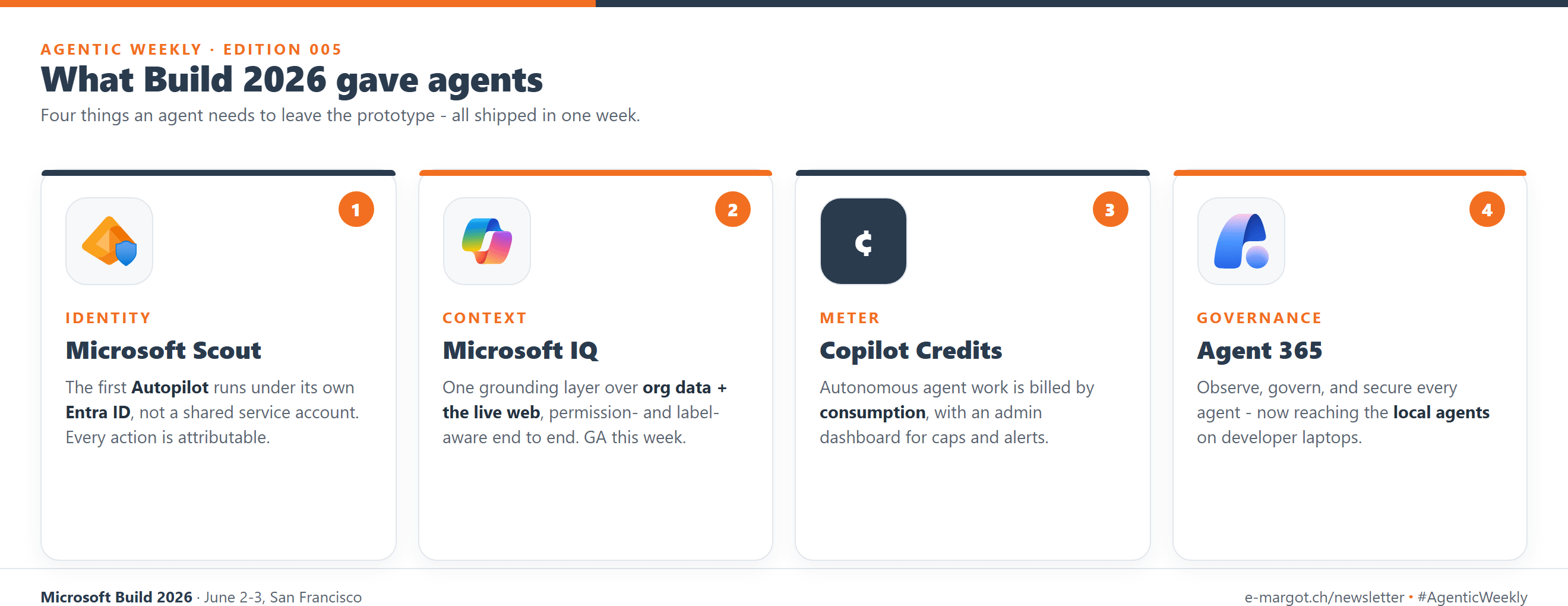
Edition 004 covered the week the build surface went agentic. Build 2026 moved a layer up and shipped the four things agents need to leave the prototype: identity, context, a meter, and governance. Identity arrived as Microsoft Scout, the first Autopilot, running under its own Entra ID rather than a shared service account. Context arrived as Microsoft IQ going GA, replacing the stitched-together Graph-plus-connectors-plus-RAG pipeline with one grounding endpoint that preserves permissions and sensitivity labels end to end. The meter arrived as Copilot Credits, with the Work IQ APIs the first product billed through a new cost-management dashboard in the Microsoft 365 admin center. And governance arrived as the biggest Agent 365 expansion yet: the SDK reached GA, and the Agent Registry now discovers the unmanaged local agents on developers' machines - Claude Code, the GitHub Copilot CLI, OpenAI Codex, OpenClaw - through Defender, Entra, and Intune working together. Read the week as one move: the parts of the agent platform that were slides in May became shipping, billable, governable surfaces in June. The interesting consequence for delivery teams is that your governance and FinOps story now has to cover agents you did not build and did not deploy, including the ones running quietly on a laptop in the engineering team.
Signal of the week
Microsoft Scout is the first Autopilot: an always-on agent with its own identity
The June 2 Microsoft 365 Blog introduced Microsoft Scout and a new category of agents called Autopilots. Autopilots are always-on agents that operate with their own Entra identity, run in the background without being prompted each time, and act within the boundaries you set - including Purview sensitivity labels and DLP enforced at action time. Scout is the first: a desktop app for Windows 11+ and macOS 12+, built on OpenClaw, grounded in Work IQ. From the first release it can create, edit, and search files; run shell commands through a tiered permission system; automate browsers via Playwright; connect to email, calendar, Teams, and OneDrive; run heartbeat checks every 15-120 minutes while you are away; launch sub-agents for research or code review in parallel; and load custom skills via SKILL.md files. Access requires Frontier program enrollment, Intune policy configuration, and a GitHub Copilot licence.
Why it matters
Scout is not a Copilot Studio agent or a Foundry agent - it is a new category with an autonomous identity, something that acts while you are not watching, under a named Entra ID your directory already governs. If you deliver agent projects, the 'where does Scout fit versus what I built in Copilot Studio' conversation starts this week. The scoping answer: Scout is personal-productivity delegation, not business-process orchestration. The two are complements, not substitutes, but clients will ask, and getting the boundary right keeps a Scout pilot from cannibalising a Copilot Studio engagement.
1Microsoft IQ
Microsoft IQ goes GA: one grounding layer, and the Work IQ APIs collapse to 10 tools
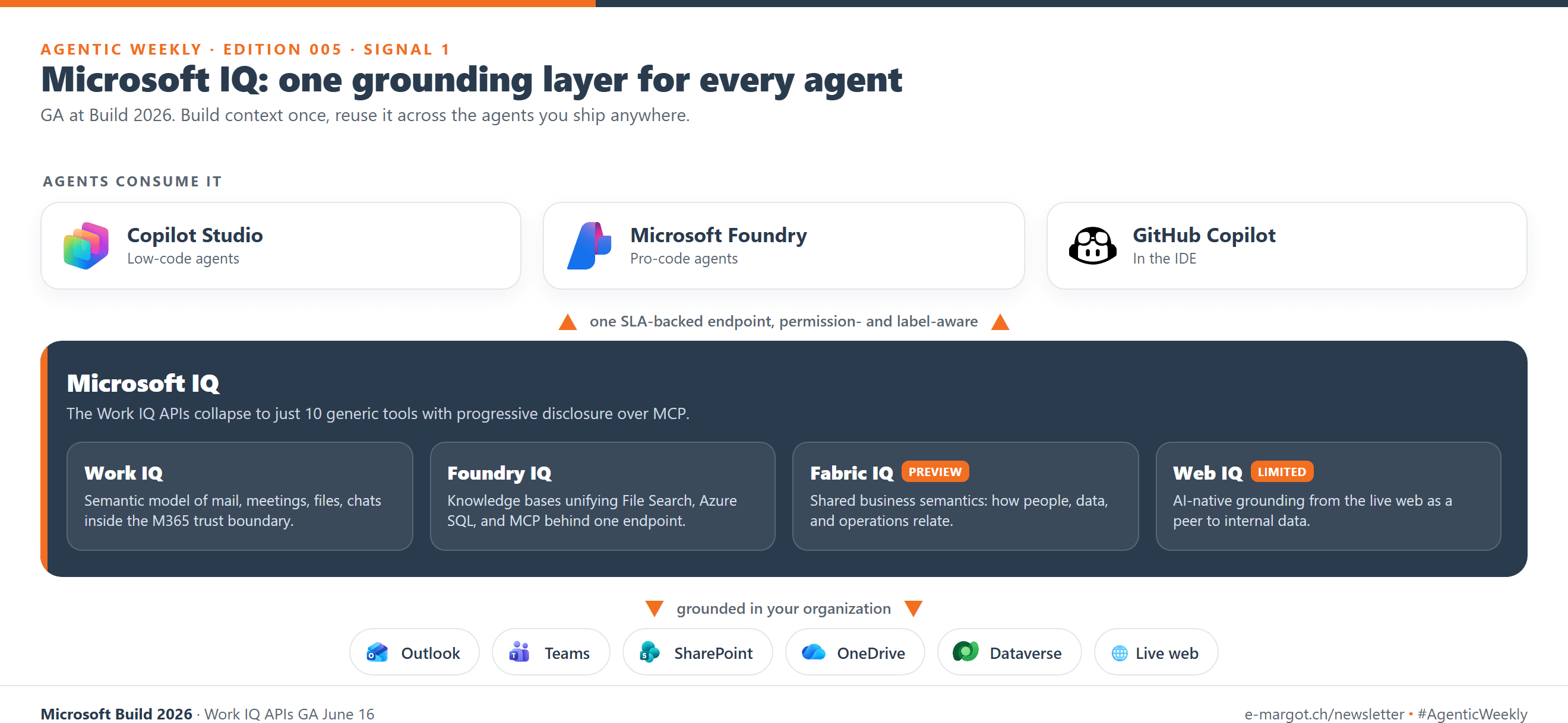
The June 2 Work IQ APIs announcement confirmed Microsoft IQ - the unified intelligence layer for agents - is generally available. The umbrella brings together Work IQ (semantic understanding of emails, meetings, documents, and chats inside the M365 trust boundary), Foundry IQ (knowledge bases unifying Work IQ, Fabric IQ, File Search, Azure SQL, and MCP behind one SLA-backed endpoint), Fabric IQ Ontology (business semantics, in preview), and the new Web IQ (live web grounding, limited access). The Work IQ APIs are the developer surface, organised into four domains: Chat (the response Copilot would return, with citations), Context (agent-ready source data rather than a synthesised answer), Tools (Microsoft 365 actions like send-email and schedule-meeting), and Workspaces (a tenant-boundary scratch space where long-running agents stash intermediate state). The standout design choice: Tools collapses to just 10 generic verbs with progressive disclosure through MCP, so you stop teaching agents hundreds of data-specific tools. The APIs are in public preview on GitHub now, GA June 16.
Why it matters
Before Build, the architecture question for an enterprise agent was 'Graph calls, connectors, or custom RAG?' After Build, it is 'Microsoft IQ first, custom RAG where coverage ends.' The 10-generic-tools surface is the practical change for builders: fewer tool definitions to maintain, lower token cost per call, and a stable action surface that does not expand every time the data does. The Workspaces domain is the quiet enabler - it is what makes long-running agents like Scout and Cowork hold state inside the tenant boundary instead of leaking it into an external store.
2Microsoft Foundry
Foundry Hosted Agents reach GA by end of June - per-agent identity, sandboxing, and safety built in
The Foundry Build 2026 recap confirmed Hosted Agents in Foundry Agent Service will be generally available by end of June, with hosted agents already in public preview across 20 Azure regions. Four capabilities ship now: a hypervisor-isolated sandbox per agent session with a dedicated persistent file system and an auto-provisioned Entra ID; source-code deployment with no container required (zip a Python 3.13/3.14 or .NET 10 project, run azd ai agent init then azd deploy); built-in content-safety guardrails that evaluate every prompt and response in real time; and Voice Live plus WebSocket support for one-click speech-to-speech. Agent Optimizer (private preview now, public preview in about 30 days) closes the improvement loop: it evaluates your agent, generates better instructions and tool descriptions, ranks them, and deploys the winner as a new version. Agent Control Specification (ACS), an open-source preview, defines eight interception points across the agent lifecycle and works across Foundry, the Microsoft Agent Framework, and LangChain.
Why it matters
The production blockers for most agent projects have been identical: sandboxing, identity, scaling, session persistence, content safety, observability. Hosted Agents absorbs all of them into the platform. ACS is the governance complement - a portable policy layer that survives a framework migration because it sits above the framework. If you have a Microsoft Agent Framework or LangChain prototype that is not in production yet, the path just got materially shorter, and ACS is the safe first pick if governance is the thing holding the deployment back.
3Pricing and Commercial
The Work IQ APIs get a meter: Copilot Credits, and a new cost-management dashboard
Build 2026 attached a billing model to the agent platform, and the Work IQ APIs are the first product to ship it. Work IQ API usage is consumption-priced in Copilot Credits, with a fixed component for the Tools domain and a variable component for Chat and Context - so retrieval and reasoning scale with use while actions carry a predictable per-call cost. Microsoft also launched a cost-management dashboard in the Microsoft 365 admin center: admins review AI credit usage, choose between prepaid and pay-as-you-go ($0.01 per credit pay-as-you-go), set spending limits for tenants, groups, and users across agents and services, and monitor credit requests from users. Work IQ APIs are the first product managed through this dashboard, and Microsoft says Copilot Studio and other Copilot Credit services will move into the same experience over time. Per-user Microsoft 365 Copilot licences are unaffected - this meter is for autonomous and third-party agent work, including when an outside agent calls your tenant's Work IQ.
Why it matters
This is the line item your next customer renewal does not have yet. When a third-party agent grounds in your tenant through Work IQ, that is now a metered, billable event against your Copilot Credit pool - which means a poorly-scoped or looping agent becomes a cost incident, not just a quality one. The cost-management dashboard is where that risk is contained: set per-group and per-user spending limits before the first autonomous agent ships, not after the first surprise invoice. Get FinOps and procurement into the room early, because 'how many Copilot seats' is now two questions - seats for people, credits for agents.
4Agent 365
Agent 365 stretches to local agents - SDK GA, plus a registry that discovers Claude Code, Copilot CLI, Codex, and OpenClaw
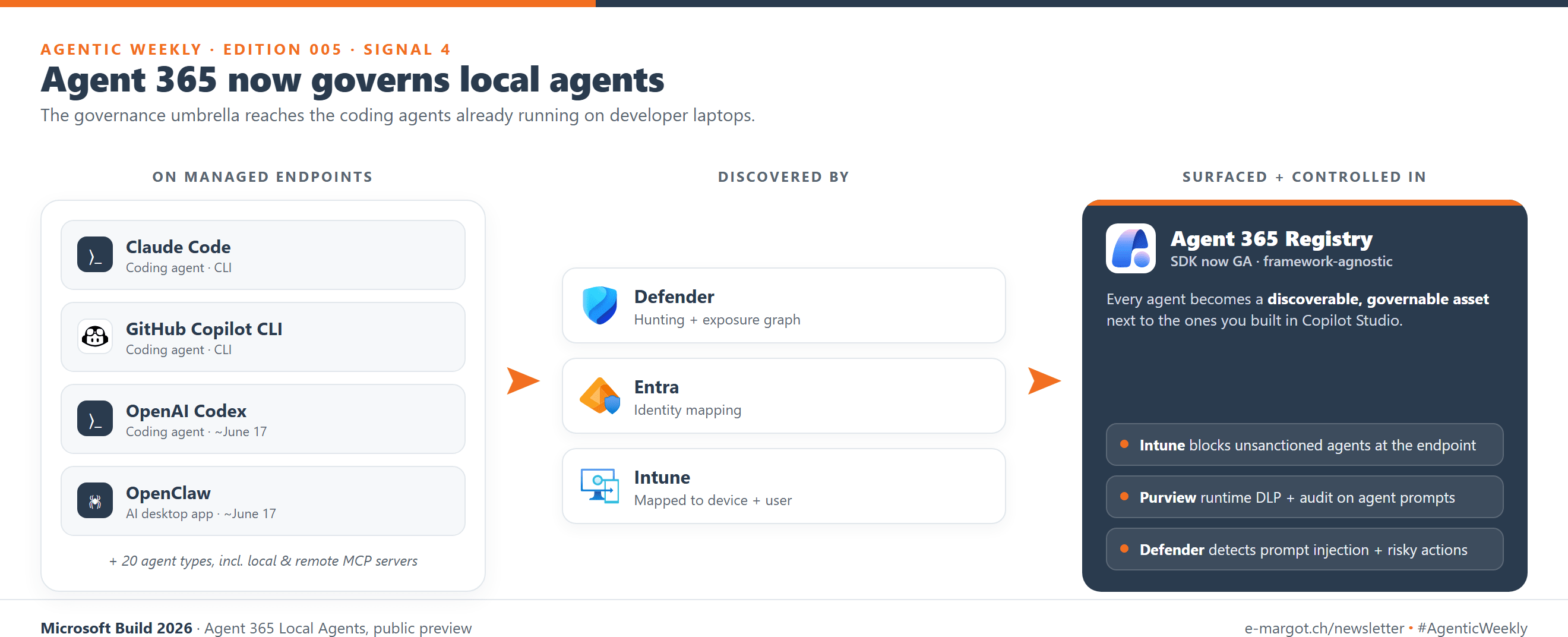
The Build 2026 security blog detailed the largest Agent 365 expansion since its May GA, and it points squarely at shadow AI. The Agent 365 SDK reached general availability: free and framework-agnostic, it lets developers build custom agents for any AI platform with observability, access controls, and compliance enforcement baked in, composing cleanly with Agent 365. The headline for security teams is the Agent 365 Agent Registry, which now surfaces unmanaged local agents discovered by Microsoft Defender, Microsoft Entra, and Microsoft Intune working together - more than 20 types, including coding agents, AI desktop applications, and both local and remote MCP servers. From the registry, Intune policies can block common execution methods for OpenClaw agents. Microsoft Purview adds agentic risk detection for the four coding agents by name - Claude Code, GitHub Copilot, OpenAI Codex, and OpenClaw - with data-exfiltration controls, runtime DLP for agent prompts (in preview with Agent 365), and Purview Audit logging all agent activity for full traceability. Defender contributes advanced hunting and an exposure graph showing how agents connect across the network.
Why it matters
Most enterprises already have developers running Claude Code or the GitHub Copilot CLI, and until this week IT had no inventory of what those local agents touched. Agent 365 now treats them as discoverable, governable assets alongside the agents you built in Copilot Studio. If you are scoping an Agent 365 rollout, the local-agent registry is the screenshot that changes the conversation with a CISO - because their first question is no longer 'what is an agent' but 'show me every agent running in my tenant, including the ones on developer laptops.' Pair the registry view with a Purview DLP policy for the four named coding agents and you have a defensible shadow-AI answer in one engagement.
- QuickWindows 365 for Agents is now GA: an Intune-managed Cloud PC that runs any agent fully isolated from the user's machine, available through Agent 365 tooling or Copilot Studio (preview). It is the high-blast-radius containment option for autonomous agents that need a real, governed place to run.
- QuickOn-device, the Microsoft Execution Container (MXC) SDK gives OS-level control over agent code execution on Windows, Linux, and macOS - process and session isolation enforced by the OS. TypeScript SDK published as @microsoft/mxc-sdk. The pairing is deliberate: MXC for local containment, Windows 365 for Agents for cloud isolation, both governed through Agent 365.
Voices to follow
- Microsoft EVP - Copilot, Agents & PlatformCharles Lamanna
Executive Vice President for Copilot, Agents, and Platform at Microsoft. He owns the strategy behind Copilot Studio, Agent 365, and the Power Platform, so when the agent stack's direction shifts, it usually shifts because of a decision his org made.
Microsoft EVP - Copilot, Agents & Platform - Microsoft Principal Cloud Advocate - Power Platform + agentsDaniel Laskewitz
Principal Cloud Advocate at Microsoft, ex-Power Platform MVP and co-founder of Forward Forever. One of the clearest voices on multi-agent systems and Power Platform governance - the bridge between the maker community and the product teams.
Microsoft Principal Cloud Advocate - Power Platform governance + agents - Copilot Studio MVPLisa Crosbie
6x Microsoft MVP, Practical AI for Business with Copilot and Agents at Barhead. Calm, hands-on voice on production-grade agent design - the one to follow when you want patterns you can ship, not just demo.
6x Microsoft MVP - YouTuber + International Speaker - ~21K followers - Microsoft Principal PM - Copilot Studio (Power CAT)Henry Jammes
Principal Program Manager for Copilot Studio on the Power CAT team at Microsoft. Deep on agent-building mechanics, governance, and the release roadmap - a first-party source on what Copilot Studio can actually do.
Microsoft Principal PM - Copilot Studio (Power CAT) - Copilot Studio MVPMikko Koskinen
AI & Copilot Lead at Forward Forever, 20+ years in the Microsoft ecosystem. Hands-on Copilot Studio and Power Platform architect with a strong governance lens - the right voice for scoping CS at enterprise scale.
Microsoft MVP Copilot Studio - AI & Copilot Lead at Forward Forever - Microsoft Partner Director - Foundry Agent ServiceJeff Hollan
Partner Director of Product at Microsoft, leading the Foundry agent platform: Agent Service, the Agent Framework, and the SDKs. The clearest source on how agents actually go from prototype to a hosted production runtime.
Microsoft Partner Director - Foundry Agent Service + Agent Framework - Microsoft CVP - Security, Compliance, Identity & PrivacyVasu Jakkal
Corporate Vice President for Microsoft Security. Defender's AI agent posture risk, the Agent 365 security integration and the wider security-for-AI story all ship out of her organisation.
Microsoft CVP - Security, Compliance, Identity & Privacy - Microsoft Principal Cloud Advocate - Power Platform Advocacy LeadApril Dunnam
Principal Cloud Advocate and Team Lead for the Power Platform Advocacy team at Microsoft, and the face of Agent Academy. If a Copilot Studio feature or governance update ships, April has usually broken it down within 48 hours.
Microsoft Principal Cloud Advocate - Power Platform + AI Demystifier
Coming up
- June 16, 2026 · Work IQ APIs reach general availability. REST, A2A, and MCP endpoints open to all developers, billed through the new cost-management dashboard.
- ~June 17, 2026 · Agent 365 local-agent discovery expands to OpenClaw and OpenAI Codex, joining Claude Code and the GitHub Copilot CLI in the first wave.
- End of June 2026 · Foundry Hosted Agents reach general availability. Tracing and evaluation for hosted agents go GA at the same time.
- July 2026 · Copilot Cowork general availability.
- August 2026 · EU AI Act enforcement begins for high-risk AI systems. The Agent 365 registry, ACS, and Purview agent governance shipping now are part of how you get ready.
This week's question
Build gave agents identity, context, a meter, and a governance umbrella in a single week - and that umbrella now reaches the Claude Code and GitHub Copilot CLI sessions running on your developers' laptops. Two questions for Monday: does your agent policy already cover those local agents, and have you set Copilot Credit spending limits before the first autonomous agent runs against your tenant?
Get Agentic Weekly in your inbox
Every Monday morning. Unsubscribe any time.