

The model and the meter: Claude Sonnet 5 lands in Copilot and Foundry the week the bill comes due
The meter that started running on June 16 sent its first real invoice on July 1, and it arrived the same week Microsoft widened your model choice on both sides of the stack. Claude Sonnet 5 rolled into Microsoft 365 Copilot's Cowork and PowerPoint and went generally available in Foundry, described as close to Opus 4.8 but cheaper, which turns model selection into a line on the bill. Sales Agent reached GA. Claude's production path in Foundry went GA on Azure hardware. And the security perimeter formally moved to Agent 365 as Defender handed off agent protection on July 1.
This week's thread: the model you pick is now a line on the invoice
Edition 007 called June 16 billing day, when Cowork and the Work IQ APIs went GA and the meter started running. This week the meter sent its first real charge: the Cowork grace period ended July 1, so consumption now bills in Copilot Credits against an actual invoice. In the same days, Microsoft widened the model choice on both sides of the stack. @Jared Spataro's surface got Claude Sonnet 5 in Copilot Cowork and PowerPoint, and @Jeff Hollan's platform took Sonnet 5 to general availability in Foundry, on the Claude-on-Azure production path that itself went GA on June 29. Anthropic describes Sonnet 5 as close to Opus 4.8 at a lower price, which is the sentence that turns model selection from a quality preference into a cost decision the moment the meter is live. Around it, first-party agents kept reaching GA with Sales Agent, and the security perimeter formally relocated as Defender handed agent protection to @Charles Lamanna's Agent 365 on July 1. The pattern of the week is that the model got better and cheaper exactly as the bill became real, so the question stopped being which model is best and became which model is worth its credits.
Signal of the week
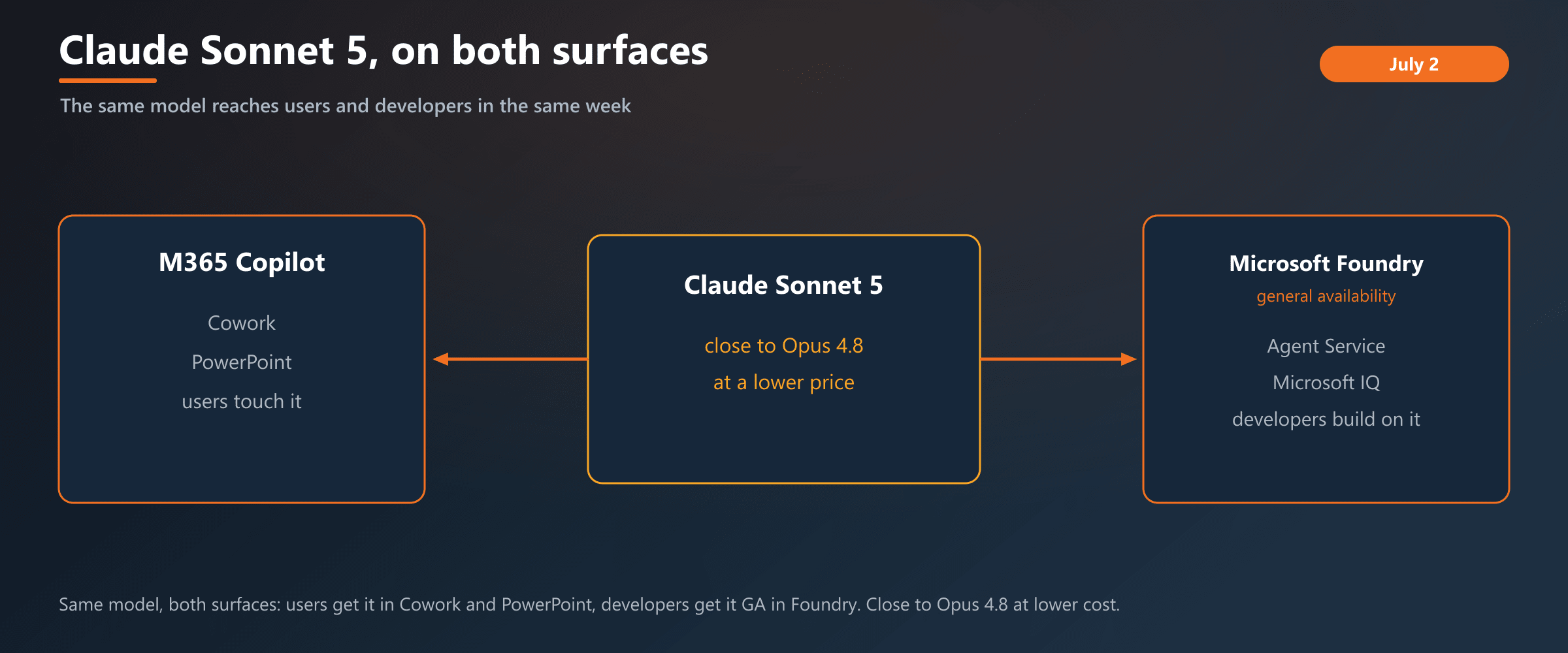
Claude Sonnet 5 lands in Microsoft 365 Copilot and Foundry in the same week
On July 2, Anthropic's Claude Sonnet 5 became available in Microsoft 365 Copilot, rolling out in Copilot Cowork and PowerPoint for agentic, multi-step work across documents, spreadsheets, and presentations. Anthropic describes it as a more capable agentic Sonnet with performance close to Opus 4.8 at lower prices. The same day, Sonnet 5 reached general availability in Microsoft Foundry, where developers use it with Foundry Agent Service and Microsoft IQ to build, ground, evaluate, and scale agentic applications, built as an upgrade to Sonnet 4.6. It arrives on the production path Microsoft opened on June 29, when Claude in Foundry went generally available on Azure.
Why it matters
The model layer just widened on both the surface your users touch and the surface your developers build on, in the same days the Cowork meter started charging. The detail that matters is the price: a model performing close to Opus 4.8 at a lower cost changes the credit math of every agentic task you run in Cowork, so model selection is now a cost decision as much as a quality one. The catch is governance: when a user picks Anthropic inside Copilot, confirm how your tenant's data-handling terms and residency apply, because the default Microsoft Copilot treatment is not automatically the same. The same model reached both surfaces in the same week, so pick where you deploy it deliberately rather than by whichever menu the user opened first.
1The meter starts charging
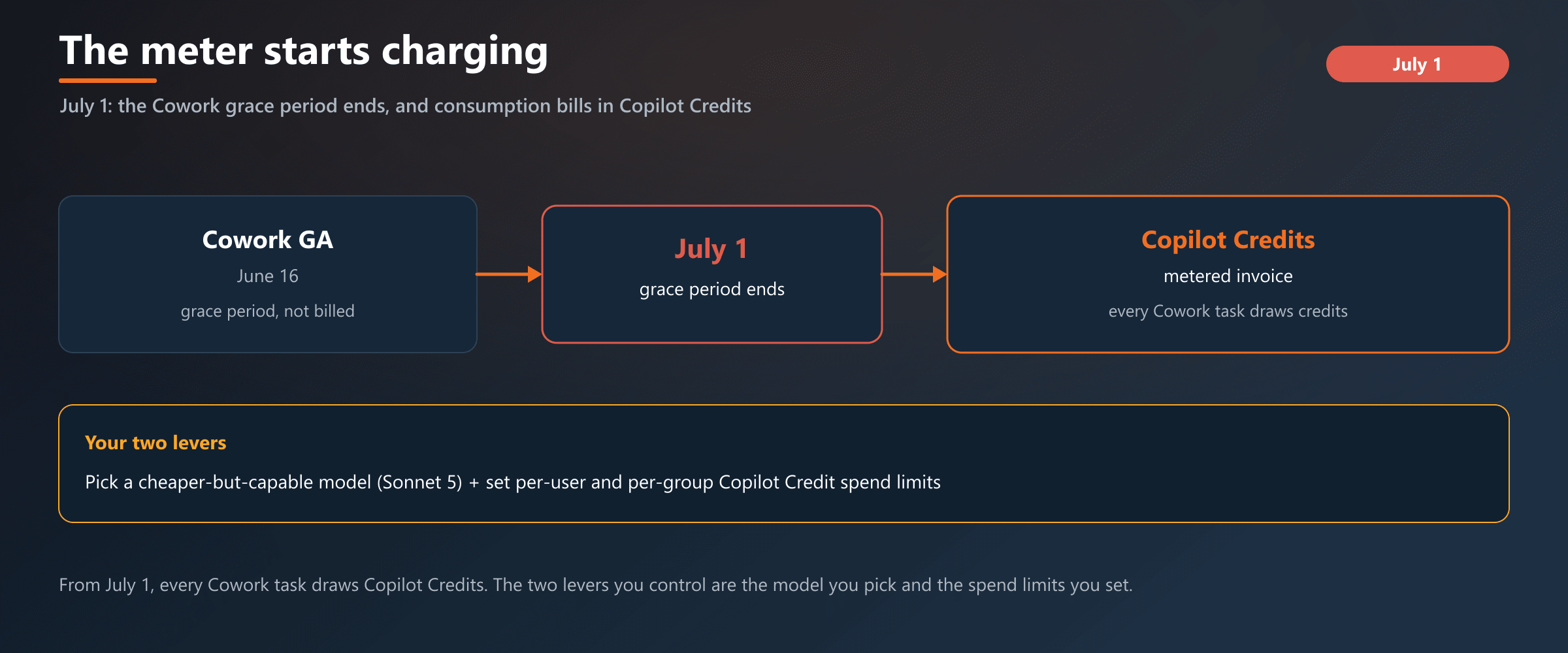
Cowork went GA on June 16 with a grace period. This week that period ended, so metered consumption stopped being theoretical and started producing invoices.
The Cowork grace period ended July 1, so the first metered invoice is real
Copilot Cowork went generally available on June 16 with a transition grace period: tenants that had at least one Frontier-program user active between March 30 and June 16, and who used Cowork in that window, were not billed for Cowork usage until July 1, 2026. That grace period ended this week. From July 1, Cowork consumption draws Copilot Credits like any other metered agent workload.
Why it matters
This is the week the meter stops being a slide and becomes a line item. Every Cowork task now spends Copilot Credits against a real bill, which is exactly why the Sonnet 5 pricing above matters and why the fine-tuned Cowork 1 model still to come is worth waiting for. Set per-user and per-group Copilot Credit spend limits now, because an ungoverned agent surface is an ungoverned cost line, and this is the invoice that will prove it.
2First-party agents keep reaching GA
Sales Agent reaches general availability in Microsoft 365 Copilot
On July 2, Sales Agent became generally available in Microsoft 365 Copilot. It grounds seller work in CRM data plus Microsoft Graph context, including emails, meetings, and accounts, bringing customer and deal intelligence into the flow of work so sellers stop switching systems to reassemble account context. With general availability, organizations can deploy it at scale across their sales teams.
Why it matters
This is the platform's current pattern: a horizontal capability, an agent grounded in Graph, shipped as a packaged first-party vertical agent you switch on rather than build. For a sales org already on Copilot, it is the shortest path to an agent that earns its credit cost, because the grounding data already lives in the tenant. It also raises the bar your custom Copilot Studio sales agents now get measured against, so know what the first-party one does before you scope a bespoke one.
3The developer surface hardens
Claude in Foundry goes GA on Azure, running on Blackwell Ultra hardware
On June 29, Claude in Microsoft Foundry reached general availability, hosted on Azure and running on NVIDIA GB300 Blackwell Ultra, giving teams a production path from prototype to scaled agentic app without leaving the Azure ecosystem. It is the foundation the Sonnet 5 general availability above is built on, and the reason a Foundry agent can call Claude as a first-class model under the same Azure governance as the rest of the stack.
Why it matters
The point is where the model runs. Claude hosted in Foundry on Azure means the call stays inside the Azure and Foundry compliance boundary, under Microsoft's data commitments, rather than routing to a separate third-party endpoint you have to assess on its own, which is often what stands between a demo and something a regulated client will approve. For anyone advising on Copilot versus custom, it makes build on Foundry with the model you actually want a real answer rather than a compromise.
4Extending the Copilot canvas
The SPFx July roadmap makes SharePoint Copilot Apps the extensibility path
The SharePoint Framework July 2026 roadmap update landed this week. It formalizes SharePoint Copilot Apps, previewed in June, as the supported way to bring interactive UI into the Microsoft 365 Copilot canvas using existing SPFx investments, and ships the quality-focused SPFx 1.23.2 release alongside the forward roadmap.
Why it matters
For any organization sitting on an SPFx investment, this is the cheapest route to a custom Copilot experience, because the components you already maintain become interactive surfaces inside Copilot with no new platform to stand up. The roadmap framing matters more than any single feature: Microsoft is telling SharePoint developers their existing skills are the on-ramp to Copilot extensibility, not a dead end, which is a genuinely useful thing to be able to tell a nervous team.
5Governance moves to Agent 365, and into the IDE
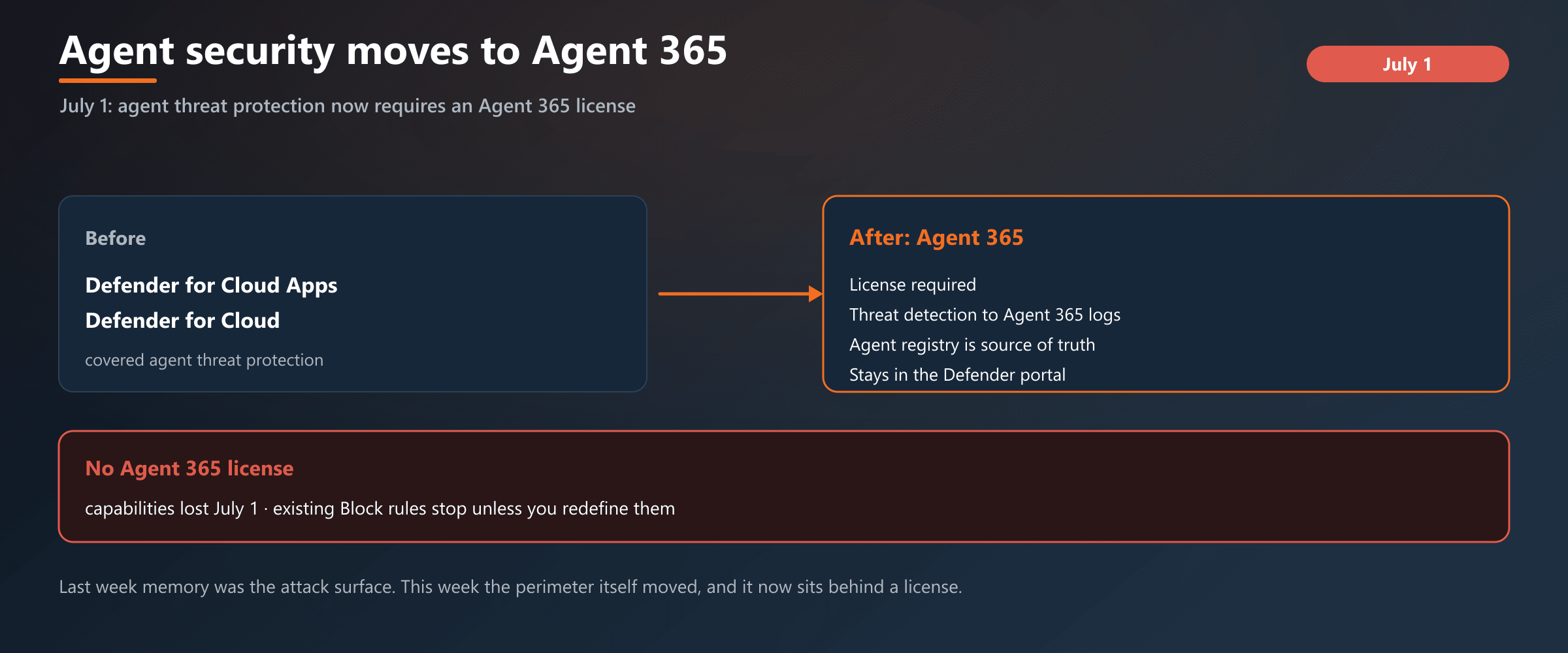
Defender hands agent security off to Agent 365 on July 1
As of July 1, agent security capabilities for Microsoft Copilot Studio and Foundry agents require a Microsoft Agent 365 license and are no longer covered by Defender for Cloud Apps or Defender for Cloud. Threat detection moves into Agent 365 observability logs, with the agent registry as the single source of truth for inventory, and stays in the Microsoft Defender portal for licensed tenants. Two sharp edges came with it: tenants without an Agent 365-eligible license lose these capabilities entirely on July 1, and any existing Agent 365 rule set to Block stops blocking that day unless you redefine it under the new real-time protection policy experience.
Why it matters
Last week two teams warned that agent memory was the attack surface; this week the perimeter itself relocated, and it now sits behind a license. If your SecOps runbooks reference Defender alerts for agent threats, they point at the wrong place as of July 1, and if you were relying on Block rules, protection may have quietly lapsed unless someone redefined them. @Charles Lamanna's Agent 365 is becoming the single control plane for agent identity, governance, and now security, which is convenient right up until you realize it is also the single license you must have provisioned for any of it to work.
GitHub Copilot managed settings and browser tools reach GA
On July 1, GitHub moved enterprise managed-settings.json to general availability, letting admins deliver locked GitHub Copilot settings from a JSON file, with copilot/managed-settings.json as the supported path. Browser tools for Copilot in VS Code went GA the same day with admin-governable permissions and existing network-domain controls, and VS Code 1.127 carries the organization-level controls.
Why it matters
Governance stopped being only a Copilot-Studio-and-Agent-365 story and reached the developer's editor. Enterprise admins can now set Copilot policy centrally instead of trusting per-repo config, which is the control security teams have been asking for since agent mode shipped. If you run Copilot at org scale, managed-settings.json is the file to own before your developers discover the browser tools on their own and you find out from a log.
6The layers you do not own
Microsoft raises partner margins on strategic AI workloads for FY27
In its July 2026 Partner Center announcements, Microsoft confirmed that beginning in FY27, CSP partners can earn higher margin for driving new-to-offer wins, seat expansion, and adoption across select strategic AI workloads. It is a direct commercial incentive aimed at partners moving customers onto Copilot and agent workloads.
Why it matters
For the partners this newsletter is written for, this is the week's most concrete signal: Microsoft is paying you more to do the adoption work the rest of this edition describes. The rewarded workloads are the ones going GA right now, Copilot, Sales Agent, Agent 365, so the margin follows the roadmap rather than fighting it. Read the fine print on what counts as new-to-offer and which workloads qualify before you build the FY27 plan around the incentive.
Voices to follow
- Microsoft EVP - Copilot, Agents & PlatformCharles Lamanna
Executive Vice President for Copilot, Agents, and Platform at Microsoft. He owns the strategy behind Copilot Studio, Agent 365, and the Power Platform, so when the agent stack's direction shifts, it usually shifts because of a decision his org made.
Microsoft EVP - Copilot, Agents & Platform - Microsoft Principal Cloud Advocate - Power Platform + agentsDaniel Laskewitz
Principal Cloud Advocate at Microsoft, ex-Power Platform MVP and co-founder of Forward Forever. One of the clearest voices on multi-agent systems and Power Platform governance - the bridge between the maker community and the product teams.
Microsoft Principal Cloud Advocate - Power Platform governance + agents - Microsoft Principal PM - Copilot Studio (Power CAT)Henry Jammes
Principal Program Manager for Copilot Studio on the Power CAT team at Microsoft. Deep on agent-building mechanics, governance, and the release roadmap - a first-party source on what Copilot Studio can actually do.
Microsoft Principal PM - Copilot Studio (Power CAT) - Copilot Studio MVPLisa Crosbie
6x Microsoft MVP, Practical AI for Business with Copilot and Agents at Barhead. Calm, hands-on voice on production-grade agent design - the one to follow when you want patterns you can ship, not just demo.
6x Microsoft MVP - YouTuber + International Speaker - ~21K followers - Microsoft Principal Cloud Advocate - Power Platform Advocacy LeadApril Dunnam
Principal Cloud Advocate and Team Lead for the Power Platform Advocacy team at Microsoft, and the face of Agent Academy. If a Copilot Studio feature or governance update ships, April has usually broken it down within 48 hours.
Microsoft Principal Cloud Advocate - Power Platform + AI Demystifier - Microsoft Principal Cloud Developer Advocate - AISeth Juarez
Principal Cloud Developer Advocate at Microsoft on AI. One of the most watchable explainers of Foundry, the Agent Framework, and GitHub Copilot for developers - deep technical content that stays accessible.
Microsoft Principal Cloud Developer Advocate - AI - Copilot Studio MVPMikko Koskinen
AI & Copilot Lead at Forward Forever, 20+ years in the Microsoft ecosystem. Hands-on Copilot Studio and Power Platform architect with a strong governance lens - the right voice for scoping CS at enterprise scale.
Microsoft MVP Copilot Studio - AI & Copilot Lead at Forward Forever - Microsoft Partner Director - Foundry Agent ServiceJeff Hollan
Partner Director of Product at Microsoft, leading the Foundry agent platform: Agent Service, the Agent Framework, and the SDKs. The clearest source on how agents actually go from prototype to a hosted production runtime.
Microsoft Partner Director - Foundry Agent Service + Agent Framework
Coming up
- Early July 2026 · Foundry hosted agents are expected to reach GA, bringing sandboxed sessions, state, filesystem access, and framework flexibility to production agent hosting. Watch for the GA post to confirm the date.
- July 2026 · The Digital Omnibus on AI is signed and published. The Council gave the text its final green light on June 29; signature and publication in the Official Journal are expected in the second half of July, with entry into force three days after publication.
- August 2, 2026 · Core AI Act provisions take effect. The Omnibus postponed the high-risk dates, not these: GPAI, prohibited-practice, and core transparency rules still start on schedule.
- November 10, 2026 · .NET 8 and .NET 9 reach end of support. Plan the move to .NET 10 LTS now, especially for any agent or Foundry workload pinned to the older runtimes.
This week's question
The meter sent its first real invoice this week, and the same days handed you a model that performs close to Opus 4.8 for less. Two questions for Monday: do you know, per agent and per team, what a Cowork task actually costs now that the grace period is over, and have you set the spend limits before finance asks? And the deeper one: now that you can pick the model on both the Copilot surface and the Foundry platform, are you choosing it for quality, for cost, or by default, and would that answer survive the first invoice?
Get Agentic Weekly in your inbox
Every Monday morning. Unsubscribe any time.