

One model, three surfaces, one day: the week model choice stopped being an architecture decision
Edition 011 was about the socket, Microsoft standardizing what agents plug into rather than fighting to own the surface. This week the vendors walked straight through it. Anthropic shipped Claude Opus 5 into Microsoft Foundry, Microsoft 365 Copilot and GitHub Copilot on the same day, with no preview gate and no staged rollout. On that same day OpenAI-operated models flipped to on by default for commercial tenants, quietly ending the subprocessor approval loop many of us have been running through client legal teams since 2025. Agent Framework moved multi-agent orchestration out of application code and into portable YAML at 1.0. Foundry hosted agents grew a visual canvas. And Defender started scoring AI agents by risk rather than just inventorying them. The model is now a dropdown your users can already see, the runtime is portable, and the only layer left that nobody can swap out is governance.
This week's thread: the model layer stopped being a decision you make once
Three signals, one shape. Claude Opus 5 landed on three Microsoft surfaces on July 24, not staged across a quarter but on a single day. On that same day OpenAI-operated models, meaning OpenAI as subprocessor rather than Azure OpenAI, became enabled by default for eligible commercial tenants. And Agent Framework's Declarative Workflows reached 1.0, so orchestration now lives in YAML that travels between Python and .NET instead of being welded into one codebase. Put those together and the picture is uncomfortable for anyone who sold a standardization story. The model is a per-prompt choice sitting in a dropdown end users can already reach. The runtime is portable. What you cannot swap out is the governance layer, and that happens to be the part Microsoft owns outright. I think that is where the differentiation moves. I am not certain, and the closing question is where I explain why.
Signal of the week
Claude Opus 5 lands in Microsoft Foundry, Microsoft 365 Copilot and GitHub Copilot on the same day
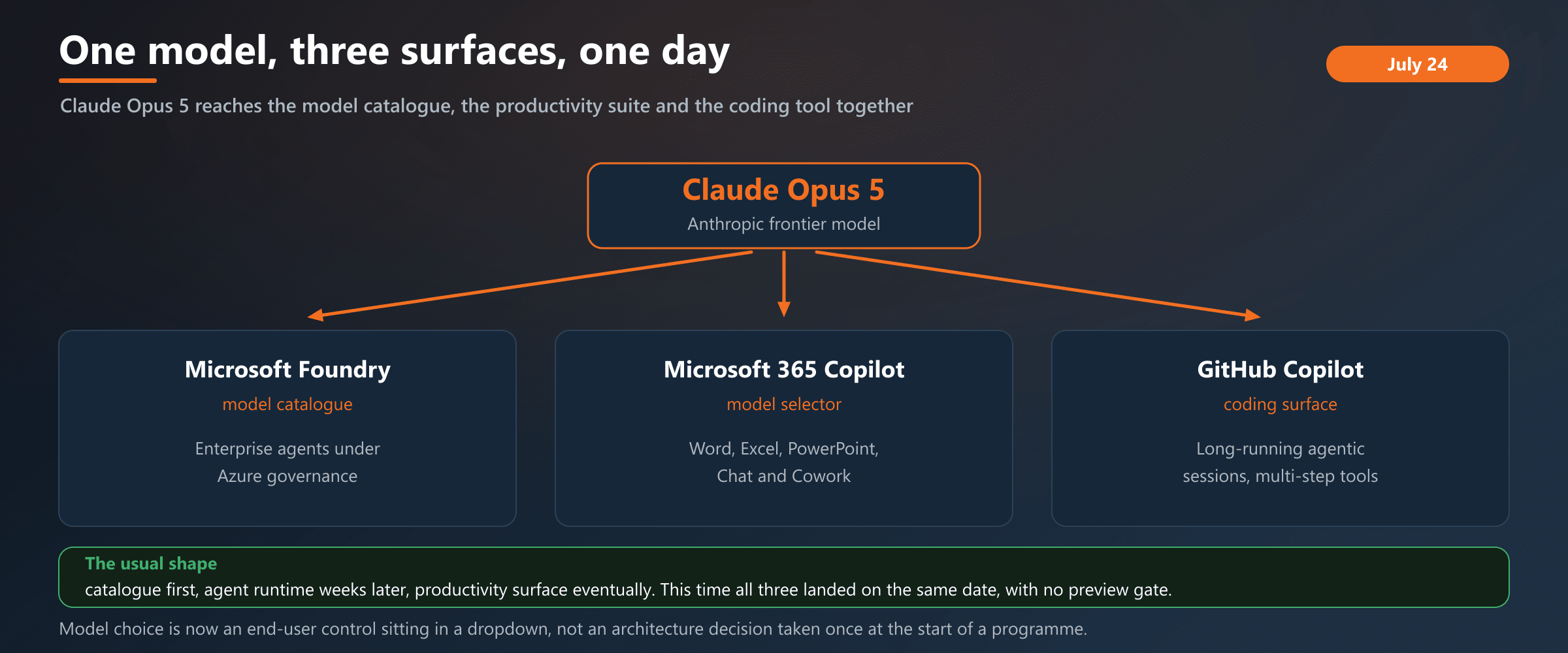
On July 24, Anthropic and Microsoft announced Claude Opus 5 across three surfaces at once. In Foundry it is in the model catalogue now, available for enterprise agents under Azure governance. In Microsoft 365 Copilot it sits in the model selector across Word, Excel, PowerPoint, Chat and Cowork, selectable per prompt or set as a preferred model. In GitHub Copilot it targets long-running coding work that needs sustained reasoning and reliable tool use across many steps. Anthropic frames Opus 5 as approaching the intelligence of Claude Fable 5 at roughly half the price. The part worth pausing on is the calendar. Microsoft has shipped non-OpenAI frontier models before, and the usual shape is catalogue first, agent runtime a few weeks later, productivity surface eventually. This time all three landed together. No preview gate, no access request, no waiting list.
Why it matters
Your users can pick this model today. Not after your rollout plan, not after your governance review. Today, from a dropdown in Word. That inverts the usual order of operations. Normally we stage a model change, benchmark it, brief the helpdesk, then announce. Here the announcement already happened, to everyone, inside the product. The only question left is whether you have an opinion ready when someone asks which one to use. So build the opinion this week. Take ten prompts that actually represent your client's work, not a benchmark suite, and run them through Opus 5 and whatever they were using on Friday. Look at the diff. Model swaps under an unchanged UI are the single biggest source of the Copilot got worse ticket, and the only defence is having run the comparison before the ticket arrives. For dev teams the calculation is simpler. If the price-performance claim holds, Opus 5 becomes the default for long agentic coding sessions and you find that out in an afternoon.
1The dropdown is the new procurement decision
Two changes landed on July 24 that together move model choice out of architecture review and into the hands of whoever is typing.
Claude Opus 5 reaches Word, Excel, PowerPoint, Chat and Cowork
Opus 5 is now a first-class option in the Microsoft 365 Copilot model selector across the core apps and Cowork. Users pick it per prompt or set it as their preferred model.
Why it matters
Model choice inside Microsoft 365 Copilot used to be a Copilot Studio conversation, which meant it was our conversation. It is now an end-user control. Decide your default per business unit before three hundred people each decide their own and your quality baseline turns into noise.
OpenAI operated models are on by default for commercial tenants
As of July 24, OpenAI-operated models, meaning OpenAI acting as subprocessor rather than Azure OpenAI, are enabled by default for all users in eligible commercial tenants.
Why it matters
If you have run a Copilot readiness workshop in the last eighteen months, you have a slide about enabling the OpenAI subprocessor and the legal review it triggers. Delete it. That step is gone at the platform level and your prerequisites list just lost one of its more tedious items.
- QuickClaude Opus 5 arrived in GitHub Copilot the same day, aimed at complex long-running coding tasks. Third surface, same date.
- QuickVS Code 1.130 adds a BYOK utility model default, letting admins decide whether utility work like commit message generation runs on the main agent model or a cheaper one. Nobody notices that cost until it is a line item across every seat you bought.
2Orchestration moves out of the codebase
Agent Framework had its heaviest week since 1.0, and the headline change is about portability rather than capability.
Declarative Workflows 1.0 puts multi-agent orchestration in YAML
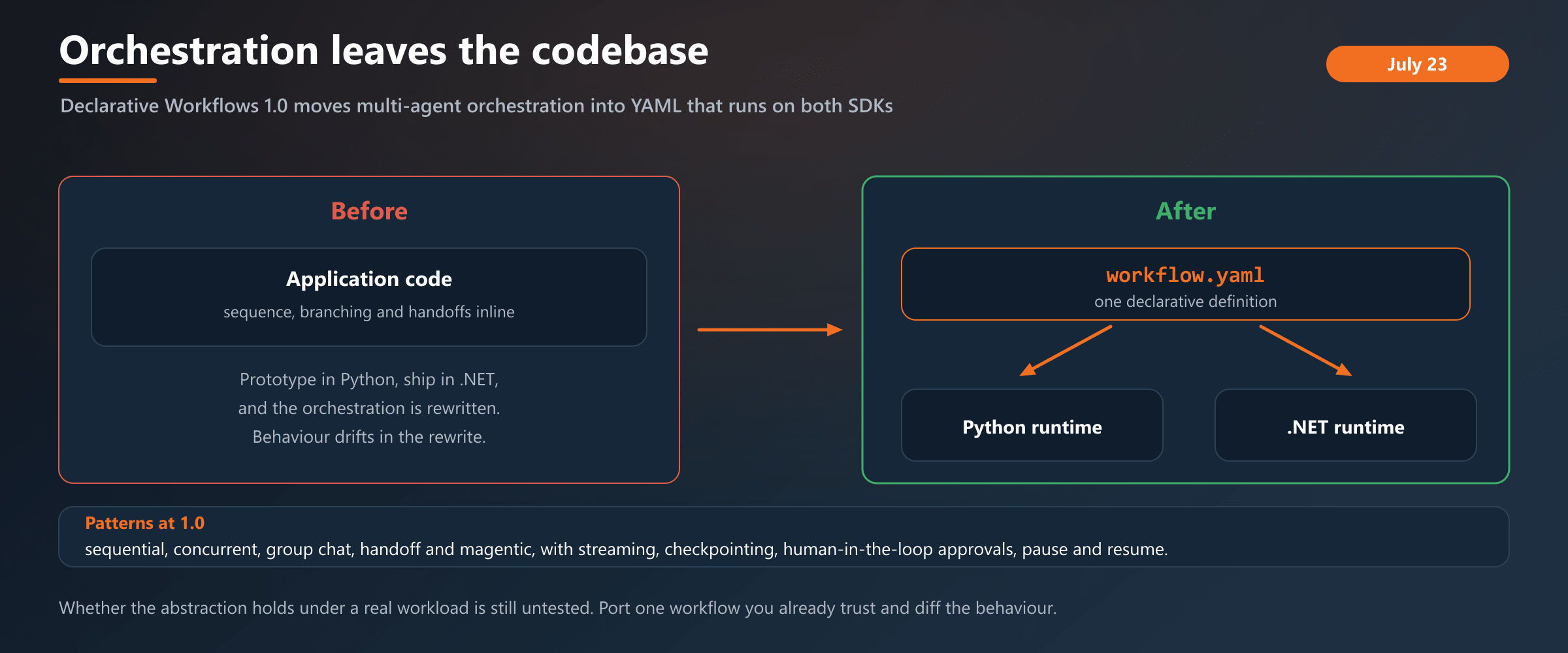
Multi-agent orchestration in Microsoft Agent Framework can now be written in YAML rather than application code, and Declarative Workflows reached 1.0 across both SDKs on July 23. Sequential, concurrent, group chat, handoff and magentic patterns are all expressible, with streaming, checkpointing, human-in-the-loop approvals and pause and resume. The same definition runs on Python and .NET. It was a busy week around it: the agent-framework-github-copilot package went 1.0.0 stable the same day, the Agent Framework Harness shipped with the agent loop, planning, memory, context management, approvals and telemetry bundled, and on July 24 agent-framework-azure-cosmos-memory arrived in preview as the first Microsoft-owned first-party memory backend for the framework.
Why it matters
Prototype in Python, ship in .NET because that is what the client's platform team supports. That has always meant rewriting the orchestration layer, and the rewrite is where behaviour drifts. YAML that runs on both ends that. Whether the abstraction actually holds under a real workload is a different question, and the honest answer is that nobody has run it in anger yet. Port one workflow you already trust and diff the behaviour. That takes an afternoon and tells you more than the release notes will. On memory: if you are running agents on hand-rolled key-value storage, Cosmos is now the first-party path, and preview is the window where your feedback still changes the API.
3Foundry grows a canvas, and I owe you a correction
The hosted agents runtime that reached GA in early July now has a low-code way in. And I got a date wrong last week.
Foundry Agent Canvas enters public preview
A visual canvas now runs the whole hosted-agent workflow, from discovery and scaffolding through configuration, testing and deployment, inside the GitHub Copilot app. It sits on top of the hosted agents runtime that reached general availability at the start of July, turning the deployment path from framework code plus CLI into something you can click through. A correction on the related story: last week I listed Toolboxes as shipping that week. It did not. Toolboxes shipped earlier and received a capability upgrade in June. What appeared was a fresh deep-dive on using it for delegated authentication. The feature is still worth your attention, but I dated it wrong and that is on me.
Why it matters
Most of my Copilot Studio agents that outgrow the platform outgrow it the same way. Too many tools, work that runs too long, or an auth pattern the connector model will not bend to. Until now the exit route was rewrite it properly in code, which is a hard sentence to say to a client who just paid for the first version. The canvas makes that conversation survivable. Same agent, different runtime, and you can show them the migration on a screen rather than in a repo. Pair it with Toolboxes if the agent acts with a user's permissions, because delegated auth is where most of my ambitious agent builds stall out.
4The agent finally gets a risk score
Inventory told you what existed. This week Defender started telling you which ones to worry about, and the Agent 365 integration left preview.
AI agent posture risk arrives in Microsoft Defender
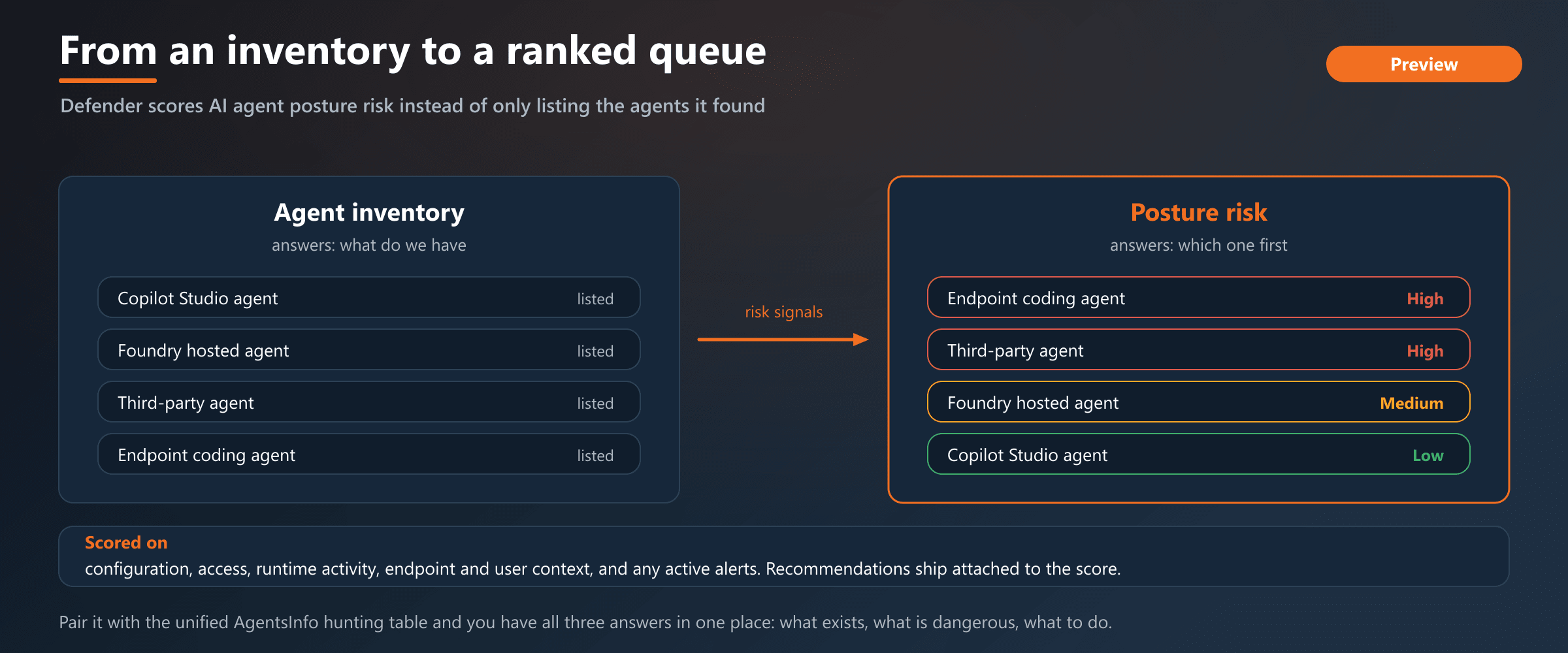
Defender now scores posture risk for AI agents, covering both enterprise agents and local agents discovered on endpoint devices. Scoring draws on configuration, access, runtime activity, endpoint and user context, and any active alerts, and it ships with recommendations attached. This builds on June's preview of local AI agent runtime protection on Windows, which inspects the agent loop itself: user prompts, tool calls, tool responses.
Why it matters
Every CISO I have briefed on agents asks a version of the same question, and it is never what agents do we have. It is which one should I worry about first. Inventory could not answer that. A ranked risk score can. Combine it with the unified AgentsInfo hunting table and you finally have all three parts of the answer in one place: what exists, what is dangerous, what to do about it. The endpoint half deserves separate attention. Coding agents and IDE extensions running on developer laptops have been the least governed AI surface in most organisations, largely because nobody could see them. That excuse expires the moment you turn discovery on. Whether anyone wants to see those results is a different conversation.
Security for Microsoft Agent 365 with Defender reaches general availability
Defender now provides discovery, posture, threat detection, investigation and real-time protection for AI agents in your tenant, gated behind an Agent 365 licence. Onboarding means enabling data collection, connecting the Microsoft 365 app connector, and connecting Copilot Studio for real-time protection of Copilot Studio agents.
Why it matters
Agent alerts now land in the queue the SOC already watches. Every agent governance conversation I have had since Agent 365 went GA died on the same objection: another dashboard nobody opens. That objection is gone. Now the unglamorous half. The AIAgentsInfo hunting table was retired on July 1, twenty-six days ago. If you still have KQL pointing at it, those queries have been quietly returning less than they used to for almost a month, and nothing about the output looks broken. Go and check yours before somebody shows you a detection report that reads clean because it is querying a dead table.
5The quieter moves
Two changes that will not make anyone's keynote but will save you time this quarter.
Copilot Studio roadmaps move to the Microsoft 365 Roadmap
Since July 2, feature updates for Copilot Studio, Sales Agent, Finance Agent and Service Agent publish to the Microsoft 365 Roadmap instead of standalone release notes. No new capabilities landed on the Copilot Studio what's new page this week; the June batch is still bedding in, including the new agent experience in production-ready preview, Microsoft IQ, reusable Skills, per-user Memory, Windows 365 for Agents MCP at GA, condition groups, and Claude Sonnet 5 plus GPT-5.5 Chat as selectable primary models.
Why it matters
This sounds like housekeeping. It is not. I have lost real hours reconciling when does this land in Copilot Studio against when does it land in Microsoft 365 Copilot across two separate publication schedules, usually while a client watched. One roadmap, one answer. Rebuild your next-90-days slide against it and it stops going stale between meetings.
Power Pages Security Agent enters preview
An AI agent that configures authentication, authorization, permissions and application security settings on a Power Pages site, without walking through half a dozen separate configuration screens. Alongside it, the Dataverse plugin for coding agents landed in the Cursor Marketplace on July 21.
Why it matters
Power Pages security is configured across too many screens by people who do not do it often enough to remember where everything lives. That is exactly the shape of problem a scoped agent handles well, and exactly the shape where a misconfiguration goes unnoticed for months. The Cursor drop is the more interesting signal to me. Microsoft shipping a first-party Dataverse plugin into a competitor's editor says they have stopped fighting for where developers sit. If your client's pro-code team already moved to Cursor, Power Platform just stopped being an argument against them.
Voices to follow
- Microsoft Principal Cloud Developer Advocate - AISeth Juarez
Principal Cloud Developer Advocate at Microsoft on AI. One of the most watchable explainers of Foundry, the Agent Framework, and GitHub Copilot for developers - deep technical content that stays accessible.
Microsoft Principal Cloud Developer Advocate - AI - Microsoft EVP - Copilot, Agents & PlatformCharles Lamanna
Executive Vice President for Copilot, Agents, and Platform at Microsoft. He owns the strategy behind Copilot Studio, Agent 365, and the Power Platform, so when the agent stack's direction shifts, it usually shifts because of a decision his org made.
Microsoft EVP - Copilot, Agents & Platform - Microsoft Partner Director - Foundry Agent ServiceJeff Hollan
Partner Director of Product at Microsoft, leading the Foundry agent platform: Agent Service, the Agent Framework, and the SDKs. The clearest source on how agents actually go from prototype to a hosted production runtime.
Microsoft Partner Director - Foundry Agent Service + Agent Framework - Copilot Studio MVPLisa Crosbie
6x Microsoft MVP, Practical AI for Business with Copilot and Agents at Barhead. Calm, hands-on voice on production-grade agent design - the one to follow when you want patterns you can ship, not just demo.
6x Microsoft MVP - YouTuber + International Speaker - ~21K followers - Microsoft VP - Azure AI FoundryMarco Casalaina
VP at Microsoft focused on Azure AI Foundry and the Foundry Agent Service. A direct source on frontier models, hosted agents, and the runtime developers build production agents on.
Microsoft VP - Azure AI Foundry Agent Service - Microsoft Software Engineer - CoworkBas Brekelmans
Software Engineer at Microsoft, started the Copilot Cowork project and previously CTO of Copilot Studio. The clearest voice on why Microsoft chose multi-model, MCP, and A2A architecture across the agent stack.
Microsoft Software Engineer, Cowork - ex-CTO Copilot Studio - Microsoft Principal Cloud Advocate - Power Platform + agentsDaniel Laskewitz
Principal Cloud Advocate at Microsoft, ex-Power Platform MVP and co-founder of Forward Forever. One of the clearest voices on multi-agent systems and Power Platform governance - the bridge between the maker community and the product teams.
Microsoft Principal Cloud Advocate - Power Platform governance + agents - Microsoft CVP - Security, Compliance, Identity & PrivacyVasu Jakkal
Corporate Vice President for Microsoft Security. Defender's AI agent posture risk, the Agent 365 security integration and the wider security-for-AI story all ship out of her organisation.
Microsoft CVP - Security, Compliance, Identity & Privacy
Coming up
- Friday July 31, 2026 · GitHub Copilot retires two Gemini models. If your fleet references those model IDs anywhere, this is the week to migrate.
- August 2026, planned · Purview auto-labeling rises from 100,000 to 500,000 files per tenant per day for SharePoint and OneDrive. The throttle that stalled large classification projects lifts.
- August 2026, planned · Agent 365 dashboard for managers in Copilot Analytics, closing the adoption loop for role-level agent rollouts.
- August 18 to September 8, 2026, 9am PT · The Microsoft 365 Copilot Agent's Playbook, a four-part Reactor series covering extending agents, grounding with Work IQ, connecting MCP apps, and evaluating them. If the sessions run weekly the MCP one falls in early September, though confirm on the series page rather than trust my arithmetic.
- September 2026, planned · SharePoint Framework 1.24 reaches GA with SharePoint Copilot Apps generally available. The preview window before the licence gate closes is now.
- November 17-20, 2026 · Microsoft Ignite, Moscone Center San Francisco and digital. The FY27 agent stack story gets finalized on that stage.
This week's question
Anthropic put a frontier model on three Microsoft surfaces in a single day. OpenAI's preferred-model status inside Microsoft 365 Copilot is three weeks old. Both vendors are now one dropdown apart inside the same product. So what happens to we standardized on model X? My instinct is that it does not survive the year, and that real differentiation moves up to orchestration and governance where Microsoft still owns the whole stack. But I have been in two client conversations this month where the security team wanted single-vendor specifically because it made the compliance story simpler, and I could not really argue with them. I do not know which pull wins. If you are having this argument inside a client right now, I would genuinely like to hear which way it went.
Get Agentic Weekly in your inbox
Every Monday morning. Unsubscribe any time.