

Below the seat count: the week Cowork learned to start on its own
Edition 012 was about model choice becoming a dropdown. This week the earnings call turned the seat count into infrastructure. Microsoft 365 Copilot passed 30 million paid seats. Azure crossed 100 billion in annual revenue. Both numbers will be quoted at you all week. Neither is the news. The shipping that mattered happened one layer below. Cowork gained event-driven tasks that autostart on an inbound email or a Teams mention. Prompt Columns went GA in Dataverse, so AI outputs live inside rows at write time. Agent Framework 1.16 and the MCP C# SDK 2.0 shipped the plumbing: bounded MCP skill discovery on a fresh stateless protocol. Model choice is settled. What activates below the seat is the new question.
This week's thread: below the seat count
Three shapes. Cowork, which spent June and July being the coworker you talked to, can now run tasks off a matching email or a Teams mention. An assistant becomes an actor the moment it decides when to start. Prompt Columns went GA in Dataverse the same week: an AI value computed whenever the underlying row changes and persisted on the record. Rows do the calling. Agent Framework 1.16 and the MCP C# SDK 2.0 shipped the plumbing under all of this: skills discovered from MCP servers, forwarded through A2A, over a stateless HTTP protocol that finally speaks Multi Round-Trip Requests. The seat count still matters because it is what makes the business case land. It is not the story.
Signal of the week
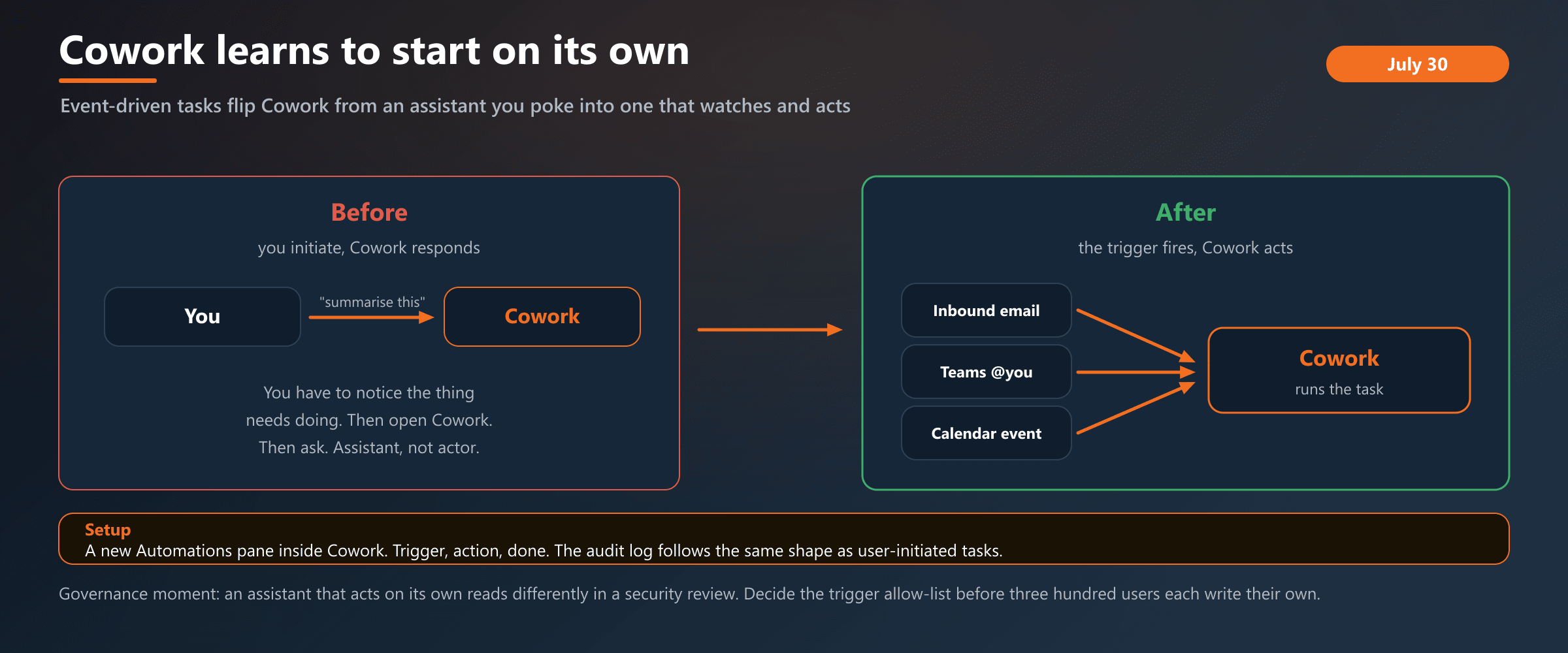
Cowork event-driven tasks reach general availability (July 30)
Cowork can now run tasks automatically when something happens: an inbound email matching a rule, a Teams message where you are mentioned, a calendar event about to start. The user configures the trigger once, and Cowork does the rest. Until now Cowork sat inside Microsoft 365 Copilot as the coworker you spoke to. Event-driven mode inverts that. Cowork watches, and when the watched thing happens, Cowork starts a task on its own and shows you the result. Setup lives in a new Automations pane. Triggers on the left, actions on the right, audit log identical to user-initiated tasks.
Why it matters
Every practitioner conversation about Copilot value ends in the same corner. Users have to notice the thing needs doing before they open Copilot to ask. Event-driven tasks remove that step for a bounded class of work. The mail arrives, the task starts, the summary lands next to the original. This is also a governance moment. An assistant that acts on its own reads differently in a security review than one that waits. Add one item to your pilot charter this week: which triggers are allowed to autostart, who reviews the outputs, where the audit log lives. Overdue rather than early.
1The seat count stopped being the news
The Q4 earnings numbers reset the buyer conversation. The rest of the week's shipping matters more.
Microsoft 365 Copilot passes 30 million paid seats (Q4 FY26, July 29)
Satya Nadella confirmed on the FY26 Q4 earnings call that Microsoft 365 Copilot has passed 30 million paid seats. Azure revenue crossed 100 billion for the year on the same call.
Why it matters
The 30 million number changes the buyer conversation more than any technical roadmap will. When a prospect asks whether anyone is actually using this, you have a one-line answer. It also reframes the governance discussion: Copilot is no longer an experiment your CIO is trialling, it is an application you administer, and the controls that were nice-to-have in the pilot phase are the ones the auditor asks about next quarter.
Copilot Dashboard launches targeted Copilot Pulse surveys (GA July 29)
Change leaders can now launch a Copilot Pulse survey directly from the Copilot Dashboard, targeting all licensed users, active users, or a defined subset. Before this, Pulse was a blast to the full licence pool. Targeted mode lets you ask the pilot cohort a different question than the mass rollout, and score adoption cleanly by group.
Why it matters
Every Copilot rollout I have run at any scale hits the same measurement problem: you need to ask different questions to different audiences and you cannot mix the responses. Blast-mode Pulse forced you to pick either your executives or your everyday users, then extrapolate. Targeted surveys close that gap inside the tool the change lead already opens. This is one of the changes that reads small in the release notes and shows up on the adoption dashboard three weeks later. If you are running a rollout in August, get your survey plan on the calendar now.
2Skills, discovered at runtime
Agent Framework and MCP moved on the same day. Skills stop being a build-time dependency and become a runtime one.
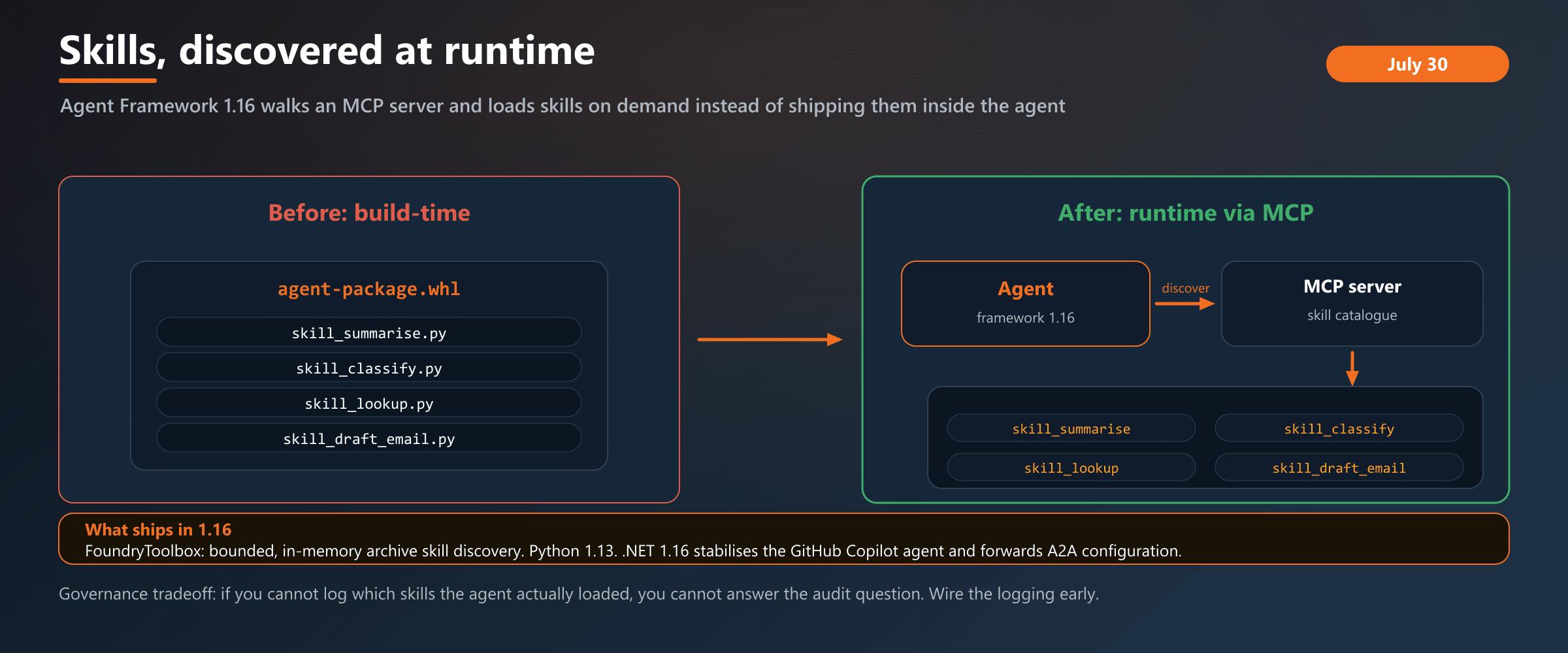
Agent Framework 1.16 lands MCP skill discovery and stabilises the GitHub Copilot agent (July 30)
Both language sides of Microsoft Agent Framework shipped this week. Python 1.13.0 adds bounded, in-memory archive skill discovery for MCP sources via the FoundryToolbox, plus reusable session stores that persist full Foundry Response sessions. .NET 1.16.0 graduates the GitHub Copilot agent from preview to stable and forwards MessageSendParams.Configuration in the A2A adapter. A companion DevBlogs walkthrough covers the discovery contract, how skills are cached, and the failure modes.
Why it matters
If you carry a hand-rolled skill loader, the MCP path is now the framework's answer. Skills as a runtime dependency rather than a build-time one is what makes the one-skill-library-across-many-agents story finally hold up. That shift is also where governance gets harder. If you cannot state which skills your agent actually loaded during a session, you cannot answer the audit question. Wire logging early.
MCP C# SDK v2.0 implements the 2026-07-28 protocol spec
The official MCP C# SDK reached v2.0 with the 2026-07-28 protocol specification. Headline changes: a stateless-first transport, standardised HTTP headers so servers and clients can be inspected with any HTTP tool, and Multi Round-Trip Requests so a single logical operation can span more than one HTTP call without inventing your own correlation ID scheme.
Why it matters
MCP has been the useful common language for months, but the operational side has been thin. Stateless transport plus canonical headers means your existing observability, WAF and retry infrastructure works out of the box instead of being lied to by whatever framing the previous transport chose. Anyone running MCP servers in production who has not looked at v2.0 should treat this as the read for the week.
3The AI moves into the row
Two Dataverse-side items pushed AI further into the platform: as a persisted column value, and as a plugin that meets developers where they already work.
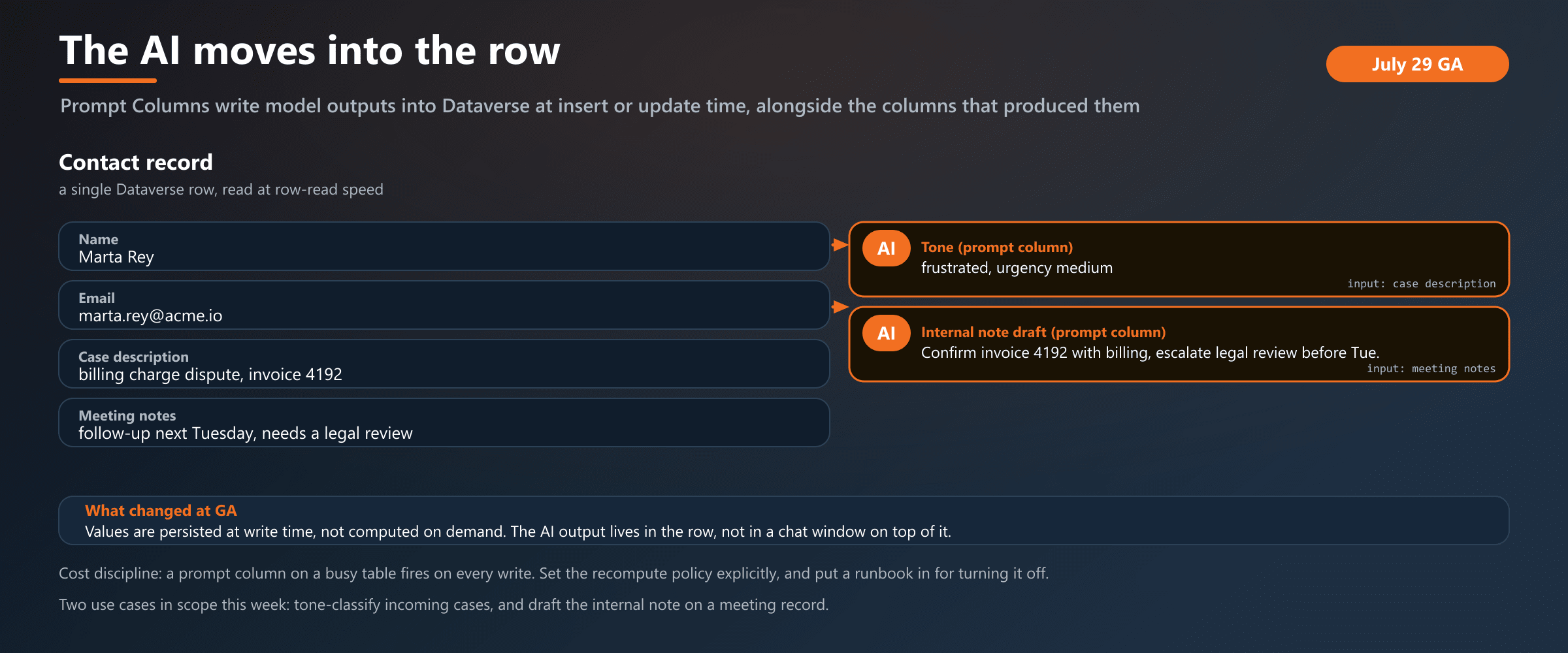
Prompt Columns reach general availability in Dataverse (July 29)
Prompt Columns are a Dataverse column type where the value is a persisted AI output generated from other columns in the same row. Define the prompt, point it at input columns, and the model result gets written and stored like any other attribute. Anyone reading the row sees the AI insight next to the source data, at row-read speed, without triggering the model. The change from the earlier preview: outputs are now persisted at write time, not computed on demand. That is the difference between a chatbot on top of your table and an AI column inside it.
Why it matters
This is the shape of AI value most enterprise clients have been asking for. Nobody wants to teach 400 users to open a chat and paste a row in. Every one of them already opens the record. Now the enrichment is on the record. Cost discipline matters more here than in the chat surfaces: a prompt column that fires on every write on a busy table can burn credits fast. Set the recompute policy explicitly, and put a runbook in place for turning it off. I have not seen the credit-burn shape in production, so trust nothing about my numbers.
Dataverse plugin for coding agents expands to OpenAI and Codex marketplaces (July 28)
Microsoft shipped the Dataverse plugin into the OpenAI and Codex agent marketplaces, following the Cursor Marketplace drop on July 21. The plugin gives a coding agent read and write access to Dataverse from wherever the agent already runs.
Why it matters
The through line is that Microsoft has stopped fighting for where developers sit. A pro-code team living in Cursor, Codex or an OpenAI-hosted agent now finds the Dataverse plugin where they already work. That closes a common client objection that Power Platform data was fenced off from the rest of the developer stack.
4The agent moves closer to the compile step
The coding surfaces got two Copilot-fronted tools this week aimed at chores nobody wants to do by hand.
MSBuild Binlog Analyzer + polyglot testing agent from the .NET team
The .NET team shipped two Copilot-fronted tools. The MSBuild Binlog Analyzer for VS Code reads binary MSBuild logs, explains build failures in prose, and offers a one-click fix from within the editor. The polyglot unit-testing agent reads a repository, writes unit tests, builds them, and confirms they pass before shipping any. VS Code 1.131.0 also released this week; the Agent Host Protocol continues to mature.
Why it matters
MSBuild logs are where a great many .NET debugging sessions get spent, and reading them by hand is a skill you had to learn separately from writing the code. Copilot reading the binlog is a genuinely useful narrow application. On generated tests, most demos get stuck on the same objection: how do you know the test is not green-because-tautological. Making build-and-run part of the loop is not proof of correctness, but it is the minimum bar most demos quietly skip.
Voices to follow
- Microsoft Software Engineer - CoworkBas Brekelmans
Software Engineer at Microsoft, started the Copilot Cowork project and previously CTO of Copilot Studio. The clearest voice on why Microsoft chose multi-model, MCP, and A2A architecture across the agent stack.
Microsoft Software Engineer, Cowork - ex-CTO Copilot Studio - Microsoft Partner Director - Foundry Agent ServiceJeff Hollan
Partner Director of Product at Microsoft, leading the Foundry agent platform: Agent Service, the Agent Framework, and the SDKs. The clearest source on how agents actually go from prototype to a hosted production runtime.
Microsoft Partner Director - Foundry Agent Service + Agent Framework - Copilot Studio MVPLisa Crosbie
6x Microsoft MVP, Practical AI for Business with Copilot and Agents at Barhead. Calm, hands-on voice on production-grade agent design - the one to follow when you want patterns you can ship, not just demo.
6x Microsoft MVP - YouTuber + International Speaker - ~21K followers - Microsoft Principal Cloud Developer Advocate - AISeth Juarez
Principal Cloud Developer Advocate at Microsoft on AI. One of the most watchable explainers of Foundry, the Agent Framework, and GitHub Copilot for developers - deep technical content that stays accessible.
Microsoft Principal Cloud Developer Advocate - AI - Microsoft EVP - Copilot, Agents & PlatformCharles Lamanna
Executive Vice President for Copilot, Agents, and Platform at Microsoft. He owns the strategy behind Copilot Studio, Agent 365, and the Power Platform, so when the agent stack's direction shifts, it usually shifts because of a decision his org made.
Microsoft EVP - Copilot, Agents & Platform - Microsoft Principal Group PM - DataverseJulie Koesmarno
Principal Group Product Manager at Microsoft, leading the Dataverse as Agent Data Platform team. Follow her to see where the governed data layer, MCP surface, and coding-agent plugins are heading before they ship.
Microsoft Principal Group PM - Dataverse as Agent Data Platform - Microsoft Principal Cloud Advocate - Power Platform + agentsDaniel Laskewitz
Principal Cloud Advocate at Microsoft, ex-Power Platform MVP and co-founder of Forward Forever. One of the clearest voices on multi-agent systems and Power Platform governance - the bridge between the maker community and the product teams.
Microsoft Principal Cloud Advocate - Power Platform governance + agents - Microsoft Principal PM - Power Platform CATReza Dorrani
Principal Program Manager at Microsoft on the Power Platform CAT team. Where the maker community goes to see new Power Apps, Dataverse, and MCP capabilities demoed in practice rather than described in a blog.
Microsoft Principal PM - Power Platform CAT - ~56K followers
Coming up
- August 2026, planned · Copilot in PowerPoint turns comment feedback into assigned follow-ups and pulls the right people into the thread. The end of chase-the-comment mode.
- August 18 to September 8, 2026, 9am PT · The Microsoft 365 Copilot Agent's Playbook, four-part Reactor series covering extending agents, grounding with Work IQ, connecting MCP apps, and evaluating them.
- September 2026, planned · SharePoint Framework 1.24 GA with SharePoint Copilot Apps generally available. The preview window before the licence gate closes is now.
- November 17-20, 2026 · Microsoft Ignite, Moscone Center San Francisco and digital. The FY27 agent stack story gets finalised on that stage.
This week's question
Three shipping items this week gave the platform new ways to start work on its own. Cowork learned to react to an inbound email or a Teams mention. Prompt Columns compute AI values whenever a row changes. Agent Framework skills now load from MCP at runtime rather than at build time. Which of these three actually reaches production first inside your client tenants? My guess is Prompt Columns, because it slots into a data model that already exists and does not need a governance conversation before someone can try it. Cowork event-driven is the more interesting shift, but the security review it triggers is real. I do not know which pull wins. If your team has an active pilot on any of the three, tell me which one turned into a real deployment and which one bounced off the review board.
Get Agentic Weekly in your inbox
Every Monday morning. Unsubscribe any time.