

The build path becomes the product: the week the M365 dev loop closed
Edition 013 was about what activates below the seat count. This week the layer we build on top of moved into view. Microsoft shipped a proper CLI for M365 Copilot extensibility, gave Dataverse agents their own Entra identity, wrote the production guide for the GitHub Copilot harness, and pushed a Power Automate plugin that reads a natural-language flow spec from the coding agent of your choice. The individual features look modest. Together they say something specific. The developer path is now the artifact, not what runs on top of it. One correction in here too, on something edition 013 and I both got slightly ahead of.
This week's thread: the developer path becomes the artifact
For two years the discourse has been about the surface. Which chat, which app, which seat. This week Microsoft moved the story one layer down. A single CLI, Work IQ Developer Tools, replaces the scattered rituals of scaffolding, provisioning, publishing and monitoring a plugin. Every Dataverse agent can now be an Entra principal with its own security role. The Copilot harness got the written contract that makes it usable in production. Power Automate has a plugin for Copilot CLI and Claude Code. I have been building agents for clients for two years and I still write a runbook every time I stand one up. This is the first week that felt like the runbook is starting to disappear.
Signal of the week
Work IQ Developer Tools (WIQD) enters public preview (August 6)
The Microsoft 365 Developer team published WIQD on 2026-08-06. One CLI for Windows, Mac and Linux, plus an agent plugin for Copilot and IDE chat, plus a Language Server Protocol implementation for plugin manifests and Adaptive Cards. It covers the whole loop: create, configure, validate, provision, package, share, ask, eval, publish, monitor. The plugin surface covers declarative agents, skills (via SKILL.md), remote MCP connectors and API plugins. Publishing targets are Partner Center for marketplace and the M365 admin center for line-of-business. `wiqd agent monitor` streams usage, health and adoption telemetry into the terminal. Announced by Sébastien Levert, Principal PM on the M365 Copilot developer experience team.
Why it matters
For anyone who has ever shipped a declarative agent or an M365 Copilot plugin, the previous workflow was seven tools stitched together with knowledge that lived in a Teams chat somewhere. I lost a full day two weeks ago tracking down why a manifest validated in the toolkit and refused in the admin center. An LSP that fires diagnostics on the manifest as you type is the first thing that would have caught it. I have not run WIQD on a real client agent yet, so I do not know how it handles the messier corners like tenant policy overlaps or connector permission drift. The shape is right. The dev loop for M365 Copilot extensibility has looked incoherent since the SDK renaming last year. This is what coherent looks like.
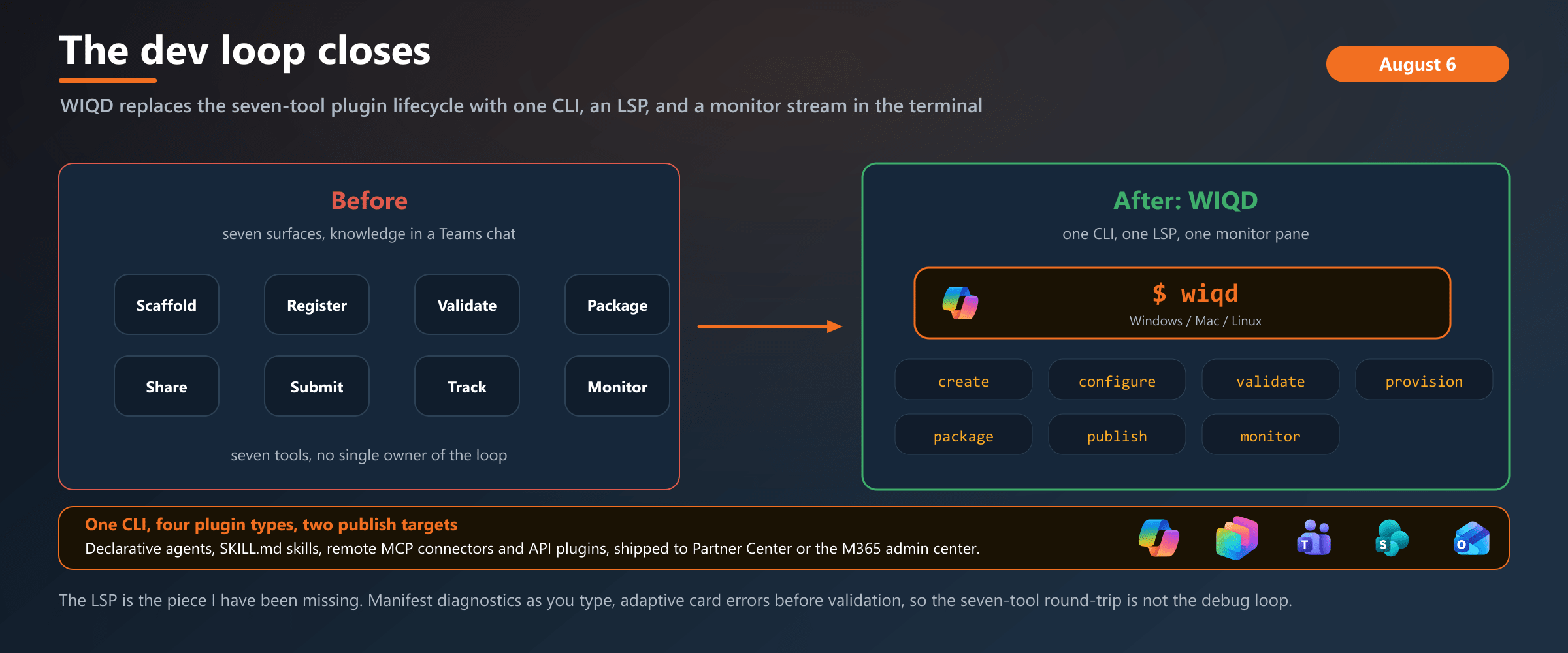
1The dev loop closes
Two shipping items land on the same theme: multi-agent workflows and the coding-agent harness are becoming first-class in the Microsoft stack. One of them comes with a correction.
The Copilot harness gets its production guide, and Agent Framework ships 1.17 (August 4)
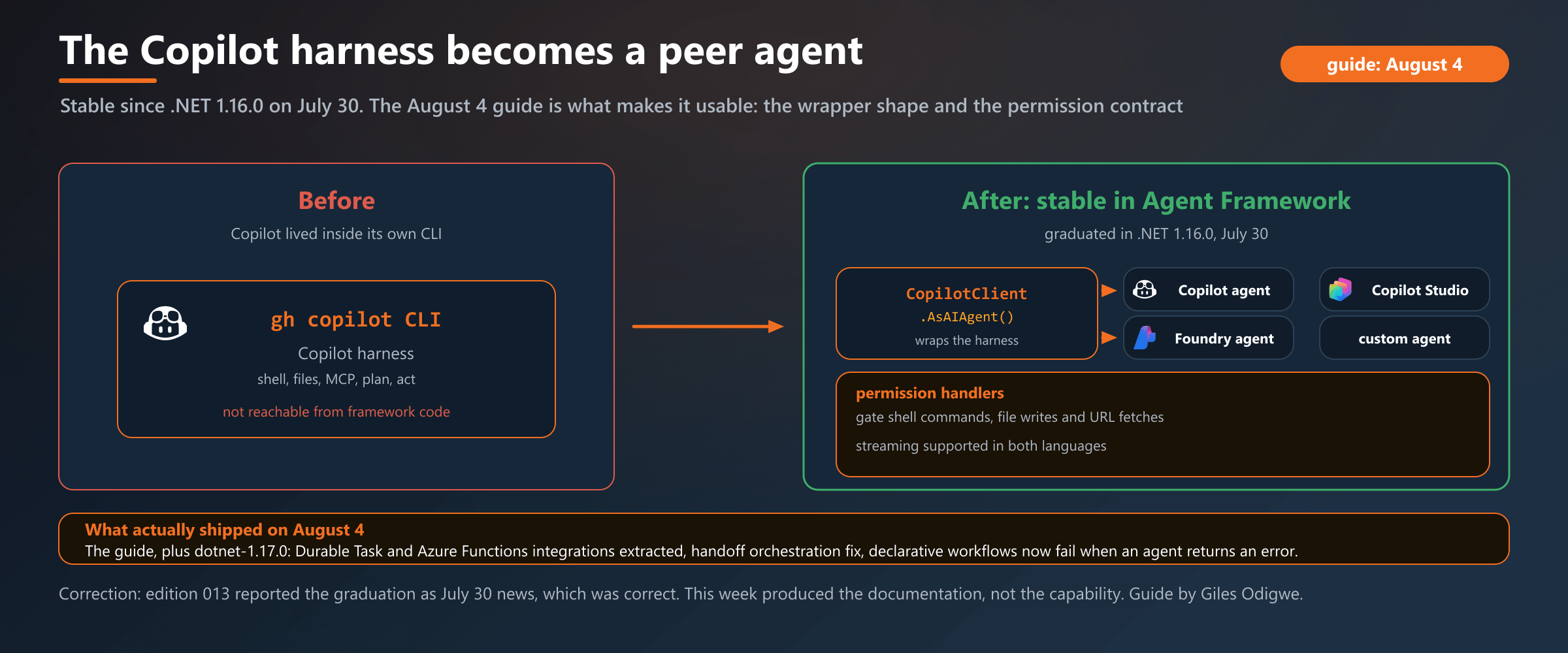
A correction on my own reporting first. Edition 013 said the GitHub Copilot agent graduated to stable, and that was right: it shipped in .NET 1.16.0 on July 30. This week produced two different artifacts. A DevBlogs deep dive on August 4 documents how to actually run the harness in production, and dotnet-1.17.0 landed the same day. The guide shows the shape: instantiate a CopilotClient, convert it via AsAIAgent() in .NET or use GitHubCopilotAgent in Python, then call standard framework methods, with permission handlers gating shell commands, file writes and URL fetches. Streaming works in both languages. Release 1.17.0 itself is smaller than the write-up implies: Durable Task and Azure Functions integrations extracted into their own packages, a handoff orchestration fix, and declarative workflows now fail when an agent returns an error instead of continuing quietly. The guide is by Giles Odigwe.
Why it matters
The distinction matters because a lot of coverage this week read the guide as the release. It is not. The capability landed last week and the documentation caught up this week, which is the normal and slightly boring order of events. What the guide changes is whether you can use it. I have been running two adjacent frameworks in production for a client migration and burning time reconciling their session state, and until there was a written permission-handler contract I was not going to put the harness in that path. The 1.17.0 change I would actually read the notes on is declarative workflows failing on agent error. If you had a workflow silently swallowing failures, its behaviour changes under you on upgrade.
VS Code 1.132 ships Agent Host, Agents Window and Side Chats (August 5)
The 1.132 release is an agent release. Agent Host lets multiple VS Code windows attach to the same agent session, Copilot or Claude or Codex, over the Agent Host Protocol, running in a dedicated process. The Agents Window gives one place to start and monitor multiple sessions with live status pills for changes, previews, subagents and browser activity. Side Chats add a `/btw` command for asking a contextual question without interrupting the current turn. On-device multilingual dictation runs via Nemotron 3.5. One breaking change worth naming: the ChatAgentHostEnabled policy is removed, so admins can no longer centrally disable the agent host through that lever.
Why it matters
If you have been juggling three editor windows for three agent sessions and losing track of which turn belongs to which, this makes the multi-agent workflow legible. The policy removal is the caveat. If your enterprise had disabled the agent host through the old policy, that control is gone in 1.132 and you need a different one before the update reaches your fleet.
2Identity moves into the data plane
The identity story around agents has been about the chat surface for a year. This week it moved to where the writes happen.
Microsoft Entra Agent ID for Dataverse enters public preview (August 6)
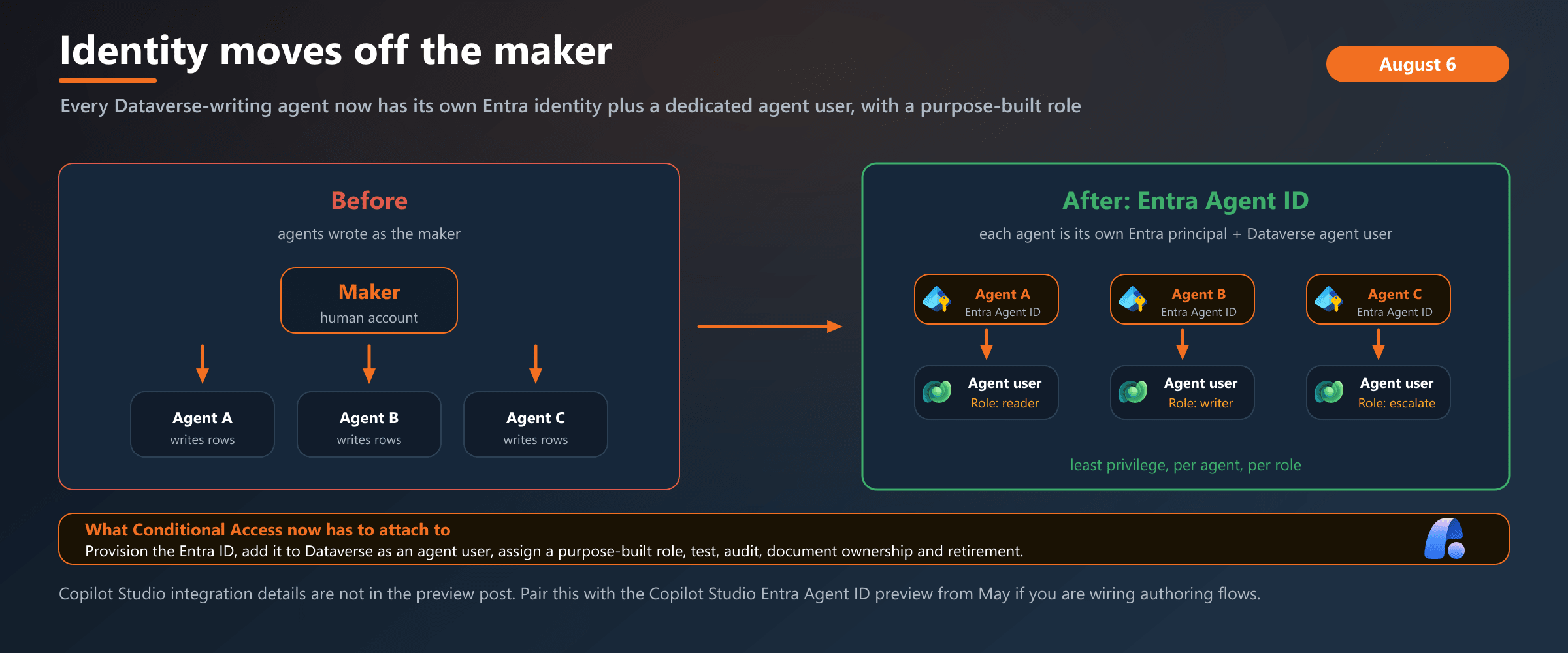
Published 2026-08-06 by Paul Liew of the Dataverse Security and Agent 365 Platform team. Every agent that touches Dataverse can now be an Entra identity plus a Dataverse agent user security principal, with dedicated least-privilege security roles instead of running under a maker's account. The admin flow: provision the Entra ID, add it to Dataverse as an agent user, assign a purpose-built role, test, audit, document ownership and retirement. Governance attaches to the identity, not the maker.
Why it matters
Every CISO I brief asks the same question. Who is that agent when it writes to the row? Until this preview, the honest answer was usually the maker, but only for now, and everyone in the room understood what that meant for audit. This closes the identity gap for Dataverse-backed agents and gives Conditional Access something to attach to. Copilot Studio integration details are not in the post, so pair it with the Copilot Studio Entra Agent ID preview from May if you are wiring this into agent authoring flows.
3The Power Platform update the RFPs will quote
Dense monthly ship note from Tiffany Treacy. Two items stand out for enterprise buyers.
Power Platform July/August 2026 feature update (August 6)
GA list: Data Grid Modern Control for canvas apps, Modern Form Control fixes for date-field ResetForm, Flow Groups (25 solution-aware flows share one process license or 250,000 actions per day), and a Power Automate plugin for AI Coding Agents in the marketplace targeting GitHub Copilot CLI and Claude Code. Preview: Power Pages Security Agent, an AI-fronted flow that lets makers configure site security through natural language with approval gates before any change commits. Deprecation: older Fluent UI hero controls in custom pages and Teams apps, with a documented upgrade path.
Why it matters
The Flow Groups license story is quiet and enormous. Anyone running more than a handful of flows in a solution has been paying per-flow because the licensing model was per-flow. Sharing one process license across 25 flows is a real cost line for teams with dozens of moderately used automations. The Power Automate coding-agent plugin is the other one to actually try. If your team already uses Copilot CLI or Claude Code, you can now let them scaffold cloud flows from the same prompt they scaffold code. I do not yet know how it handles solution-aware flows with complex connection references, so plan a small test.
4Smaller ships, useful angles
One sample worth pointing colleagues at when the local-agent question comes up.
Foundry Local ships a live speech-to-text sample in C# (August 5)
The .NET blog published a walkthrough that runs speech-to-text on device against a compact Nemotron model, with lifecycle management (load, unload, swap models) surfaced in the sample. It is a sample, not a product release, but it is the cleanest reference so far for a Foundry Local integration inside a Windows client.
Why it matters
Every conversation about local agents at Witivio starts with can it run without egress and ends at speech. If you have been trying to demo an on-device voice loop to a client and finding the sample surface thin, this fills the gap.
Voices to follow
- Microsoft Principal Cloud Advocate - Power Platform Advocacy LeadApril Dunnam
Principal Cloud Advocate and Team Lead for the Power Platform Advocacy team at Microsoft, and the face of Agent Academy. If a Copilot Studio feature or governance update ships, April has usually broken it down within 48 hours.
Microsoft Principal Cloud Advocate - Power Platform + AI Demystifier - Microsoft Principal Cloud Developer Advocate - AISeth Juarez
Principal Cloud Developer Advocate at Microsoft on AI. One of the most watchable explainers of Foundry, the Agent Framework, and GitHub Copilot for developers - deep technical content that stays accessible.
Microsoft Principal Cloud Developer Advocate - AI - Microsoft AI Developer Relations - GitHub CopilotBurke Holland
AI Developer Relations leader at Microsoft, one of the most-followed voices on GitHub Copilot, VS Code, and AI-assisted coding. The place to see agent mode and the coding-agent workflow demoed for real.
Microsoft AI DevRel - GitHub Copilot + VS Code - Microsoft EVP - Copilot, Agents & PlatformCharles Lamanna
Executive Vice President for Copilot, Agents, and Platform at Microsoft. He owns the strategy behind Copilot Studio, Agent 365, and the Power Platform, so when the agent stack's direction shifts, it usually shifts because of a decision his org made.
Microsoft EVP - Copilot, Agents & Platform - Microsoft Principal Group PM - DataverseJulie Koesmarno
Principal Group Product Manager at Microsoft, leading the Dataverse as Agent Data Platform team. Follow her to see where the governed data layer, MCP surface, and coding-agent plugins are heading before they ship.
Microsoft Principal Group PM - Dataverse as Agent Data Platform - Microsoft Principal Cloud Advocate - Power Platform + agentsDaniel Laskewitz
Principal Cloud Advocate at Microsoft, ex-Power Platform MVP and co-founder of Forward Forever. One of the clearest voices on multi-agent systems and Power Platform governance - the bridge between the maker community and the product teams.
Microsoft Principal Cloud Advocate - Power Platform governance + agents - Microsoft Principal PM - Power Platform CATReza Dorrani
Principal Program Manager at Microsoft on the Power Platform CAT team. Where the maker community goes to see new Power Apps, Dataverse, and MCP capabilities demoed in practice rather than described in a blog.
Microsoft Principal PM - Power Platform CAT - ~56K followers - Copilot Studio MVPLisa Crosbie
6x Microsoft MVP, Practical AI for Business with Copilot and Agents at Barhead. Calm, hands-on voice on production-grade agent design - the one to follow when you want patterns you can ship, not just demo.
6x Microsoft MVP - YouTuber + International Speaker - ~21K followers
Coming up
- August 17, 2026 · NuGet API key durations shorten to 30 days. Rotate before the deadline or your publish pipelines break.
- August 18 to September 8, 2026, 9am PT · The Microsoft 365 Copilot Agent's Playbook, four-part Reactor series covers extending agents, grounding with Work IQ, connecting MCP apps, and evaluating them.
- August 2026, planned · SQL Server as a Copilot Studio knowledge source (roadmap). Removes the Dataverse-mirror friction on enterprise operational data.
- September 2026, planned · SharePoint Framework 1.24 GA with SharePoint Copilot Apps generally available. The preview window before the licence gate closes is still open.
- November 17-20, 2026 · Microsoft Ignite, Moscone Center San Francisco and digital. The FY27 agent stack story gets finalised on that stage.
This week's question
If the developer path is becoming the artifact, what is the smallest agent worth publishing? WIQD makes the loop cheap enough that a single-skill plugin to your admin center could ship in an afternoon. My instinct is that the value shifts to composition, many small skills wired together, rather than one monolithic declarative agent. I honestly do not know. I have not seen a client production deployment yet where the many-small-skills pattern outperformed one thick agent, so I could be wrong. If your team has one of each in flight, tell me which one is easier to keep alive after the first release cycle. That is the answer that matters.
Get Agentic Weekly in your inbox
Every Monday morning. Unsubscribe any time.