
Built for the bad day: the week the agent stack started planning for failure
Edition 014 was about the build path becoming the artifact. This week the story moved past the build entirely. Microsoft shipped change tracking with before-and-after diffs, workflow checkpoints you can resume from, a session you can explicitly release, a chat client that fails over to a second model, and two model retirements that landed while most of us were not looking. I have been reading release notes for three years and this is the first week where the through-line was not a new capability. It was recovery.
This week's thread: the agent stack grows an operations layer
Every significant artifact this week is designed around something going wrong. Drift you did not authorise. A run that dies halfway. A model that disappears from under a production deployment. A provider that returns an error at the worst moment. None of it is glamorous and none of it will lead a keynote. It is also the exact list of things that have burned me on client engagements, in that order. The build story was 2025. This is the year the tooling admits that shipping is the start, and that the interesting work begins the first time something breaks in front of a customer.
Signal of the week
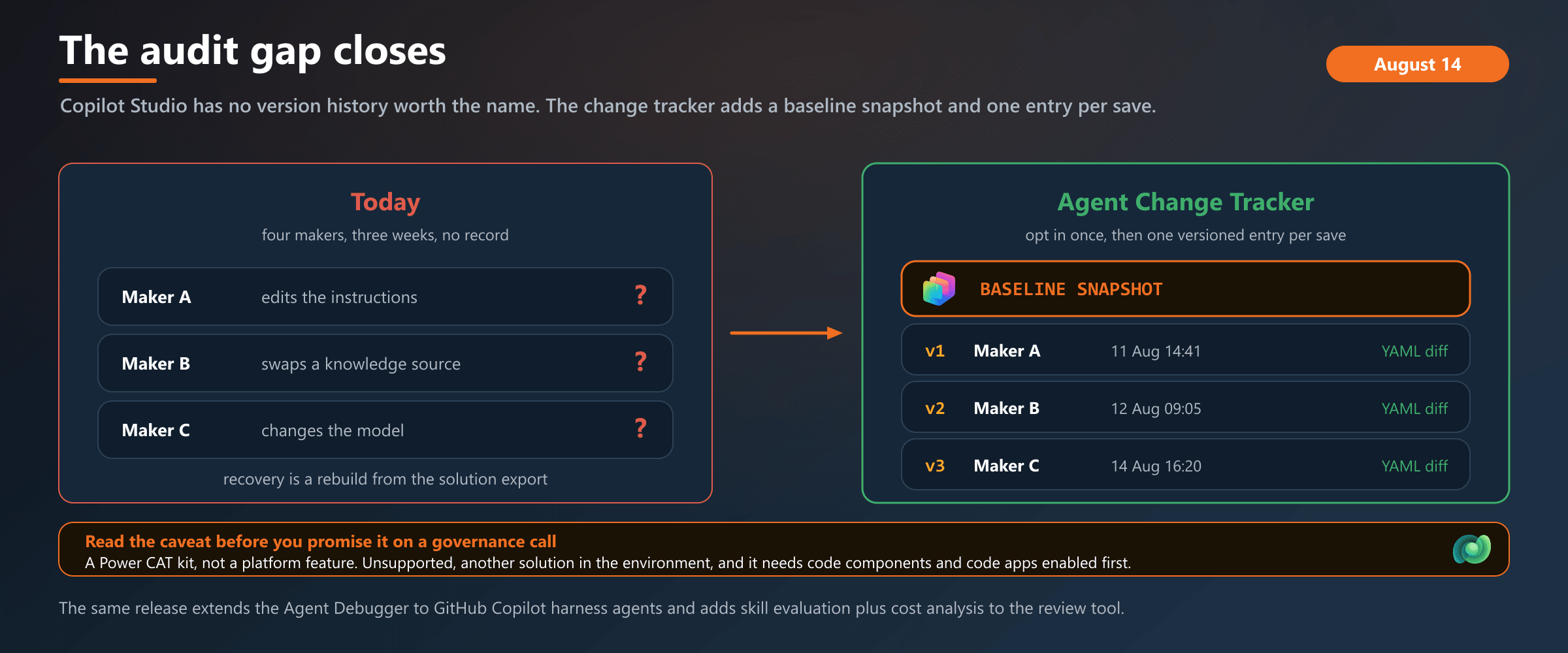
Copilot Agent Kit ships an Agent Change Tracker (August 14)
Power CAT released the August 2026 Copilot Agent Kit. The headline addition is the Agent Change Tracker: you opt an agent into continuous tracking, the kit takes an initial snapshot, and from then on it builds a versioned timeline of what changed, who changed it, and when it was saved. It gives you a before-and-after comparison, the maker's identity, and the underlying YAML. The same release extends the Agent Debugger to GitHub Copilot harness agents, adds a review tool covering skill evaluation and cost analysis, brings bulk actions and multilingual metadata extraction to Agent Inventory, and lets Test Automation accept adaptive cards as test responses. Installation requires code components and code apps to be enabled in the environment first.
Why it matters
I cannot currently answer the question "what changed in this agent since Tuesday" for any client, and I get asked it constantly. Copilot Studio has no native version history worth the name, so the honest answer has always been a shrug and a rebuild from the solution export. That is embarrassing on a governance call. A first-party change log with maker attribution and a YAML diff closes the single biggest audit gap in the product. The obvious caveat needs flagging: this is a Power CAT kit, not a platform feature, which means it is unsupported, it is another solution in your environment, and it depends on code apps being turned on. I have not run it under a real tenant load yet. But it is the closest thing to an answer that exists.
1The run learns to survive itself
Two releases landed on the same day, both adding primitives that only matter once a run has already failed. Neither is a feature you demo. Both are the difference between a workflow you can put in front of a customer and one you cannot.
Agent Framework Python 1.14.0, and a breaking change to read twice (August 13)
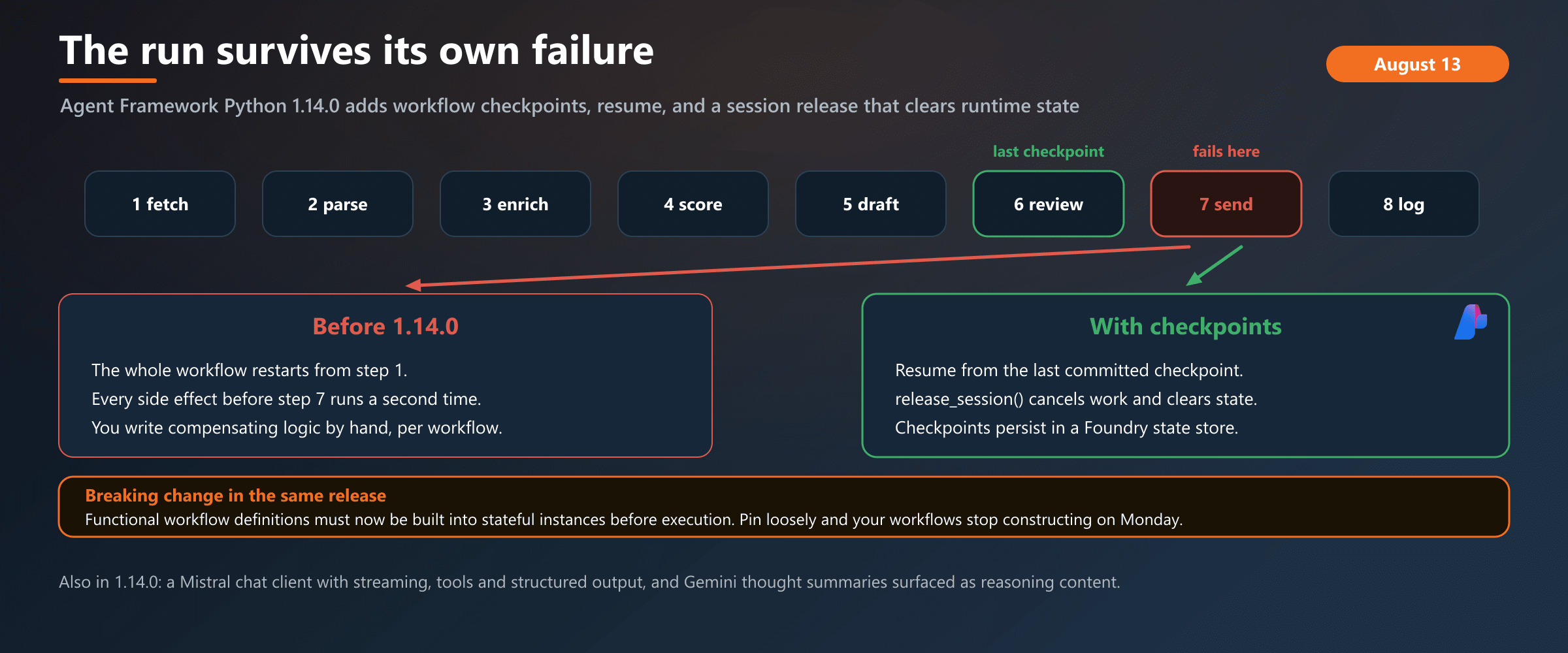
The release adds checkpoint creation and resume for workflows, plus a release_session() method on BackgroundAgentsProvider that cancels work and clears per-session runtime state. It also brings a Mistral chat client with streaming, tools and structured output, Gemini thought summaries surfaced as reasoning content, and provider-based Foundry state stores for sessions and checkpoints. One breaking change comes with it: functional workflow definitions must now be built into stateful instances before execution.
Why it matters
Checkpoint and resume is the feature that moves long-running agent work out of the demo category. Until now a multi-step workflow that died at step seven died completely, and I have written more compensating logic for that than I would like to admit. The breaking change is the thing to actually act on. If you pin loosely and your build picks up 1.14.0 on Monday, your workflows stop constructing, and the error will not obviously say "read the changelog".
Microsoft.Extensions.AI 10.9.0 adds routing and failover (August 13)
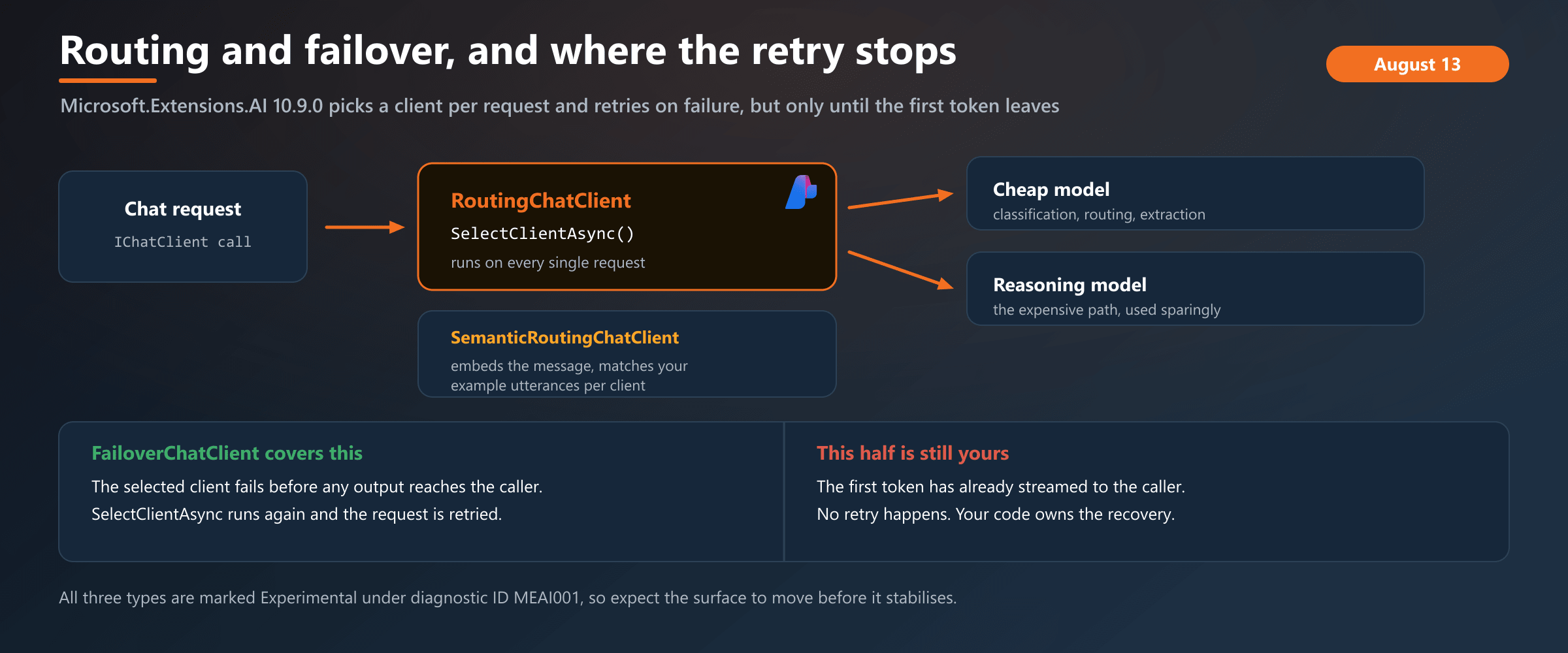
Three new types landed in Microsoft.Extensions.AI 10.9.0. RoutingChatClient is an abstract base that calls SelectClientAsync on every request to pick a downstream client. SemanticRoutingChatClient routes by meaning, embedding the incoming message and matching it against example utterances you supply per client. FailoverChatClient extends the routing base with retry: when the selected client fails before any output reaches the caller, it re-selects and tries again. All three are marked Experimental under diagnostic ID MEAI001.
Why it matters
Cheap model for classification, expensive model for reasoning, is a pattern every team invents independently and implements badly. Having it in the framework rather than in each project's helper class is worth more than it sounds. The failover boundary is the detail I would underline: it retries only when the failure happens before output reaches the caller, which means a mid-stream failure is still yours to handle. That is the correct design and it is also exactly where people will assume they are covered when they are not.
2The model under your feet moves
Preview models retire on a real clock and nobody sends you a calendar invite. Two dates passed this week and five more land before September.
Two Foundry retirements landed mid-week, five more before September
MAI-Image-2 and MAI-Image-2e, both preview models, reached retirement on 15 August. Their replacements are MAI-Image-2.5 and MAI-Image-2.5-Flash. DeepSeek-R1 retired on 13 August, replaced by DeepSeek-V4-Pro. Both dates have already passed. Before the end of the month the schedule takes gpt-chat-latest version 2026-05-28 on 28 August, both preview versions of model-router on 30 August, and gpt-realtime-2 preview, TimeGEN-1 and tsuzumi-7b on 31 August.
Why it matters
A demo environment of mine broke on exactly this, and I spent an afternoon hunting a deployment error that was a published date all along. Model-router going on 30 August is the one I would check today, because routing is the kind of thing you configure once and never look at again. Put the retirement page in your bookmarks bar, not in a runbook nobody opens. And note the pattern: everything retiring this month is a preview version, which is precisely the tier that quietly ends up in production because it was the only one available when the project started.
3The admin surface moves under you
One of these gives administrators a fleet view they have never had. The other changes a URL on Tuesday and will break somebody's proxy config. Both are jobs for this week, not next quarter.
Multi-tenant agent management enters public preview (announced August 10)
Administrators can now view and manage agents across multiple tenants from one experience in the Microsoft 365 admin center. It gives a consolidated agent inventory, the ability to add, install or block agents across eligible tenants, tenant-specific risk and activity insights, and a tenant switcher that avoids signing out or holding separate admin accounts. Risk and activity insights for a given user require an Agent 365 licence assigned to that user. For CSP partners working through Granular Delegated Admin Privileges, actions stay scoped to the administrator's delegated role in each customer tenant.
Why it matters
This is built for people like me. I hold delegated access into a lot of customer tenants, and until now checking agent sprawl meant a sign-in cycle per tenant, which in practice means it happened quarterly at best. Blocking a risky agent across a fleet in one action changes what a managed service can credibly offer. Read the licence footnote carefully before you price anything. The inventory is broad, but the risk insights that make it useful are gated per user on an Agent 365 licence. How that lands commercially for a partner managing fifty small tenants, I genuinely do not know yet.
The Copilot app changes address and grows a green shield (announced August 14, live August 18)
Microsoft told partners on 14 August that starting 18 August the Copilot web, desktop and mobile apps change. The web app moves from m365.cloud.microsoft to copilot.cloud.microsoft, with automatic redirection unless the new URL is blocked in the organisation. Users get account labels, a green shield marking a Microsoft Entra work account, and distinct backgrounds to separate work from personal. The app takes a simplified name and icon. An early preview of the Windows and Mac desktop experience lands 18 August, with broad deployment from mid-September. Security, compliance and governance controls are unchanged.
Why it matters
The interesting part is not the shield, it is the redirect. If your proxy or firewall allow-list is pinned to m365.cloud.microsoft, tomorrow your users hit a wall and the help desk hears about Copilot being down. Every regulated client I work with maintains exactly that kind of hand-curated allow-list, and nobody updates it until something breaks. Add the cloud.microsoft wildcard now. That is a fifteen-minute job today and a bad Tuesday if you skip it.
4Model choice stops being a setup decision
The editor caught up with the thing everyone was already doing by hand.
VS Code 1.133 makes provider switching stable (August 12)
The August release moves model provider switching to stable: you can change providers between turns without reconfiguring the agent host, including toggling between Anthropic and Copilot models inside a single session. An experimental option opens the Agents window without GitHub sign-in for users who have configured an API key. The agent host continues to run harnesses in a dedicated process over the Agent Host Protocol, with the Copilot agent powered by the Copilot SDK. Sticky scroll for chat prompts also went stable.
Why it matters
Switching provider between turns without a restart sounds cosmetic and is not. It turns model choice into something you evaluate while working rather than something you commit to at setup, and that quietly kills a lot of the "which model should we standardise on" meetings. The sign-in change is the one I did not expect. Reaching the Agents window with an API key and no GitHub account loosens a coupling that has been assumed since the beginning, and I am genuinely unsure whether that is a considered direction or an experiment that gets pulled.
- QuickThe monthly partner update posted 13 August details the Agentic Business Solutions specialization, formed on 31 July by merging Low Code Application Development with Intelligent Automation. Note the split: the merger took effect end of July, the post is what is new this week. One qualifying pathway needs two new Copilot Studio deployments at a minimum of $10,000 TTM each. That floor is Microsoft stating what it considers a real project rather than a pilot.
- QuickQuiet week in Power Automate and Power Platform, and quiet in security too. The Defender XDR what's-new page still ends at July, so nothing shipped there in the last seven days that I can point at. The only security-adjacent action is the allow-list change above.
Voices to follow
- Microsoft Principal Cloud Developer Advocate - AISeth Juarez
Principal Cloud Developer Advocate at Microsoft on AI. One of the most watchable explainers of Foundry, the Agent Framework, and GitHub Copilot for developers - deep technical content that stays accessible.
Microsoft Principal Cloud Developer Advocate - AI - Microsoft EVP - Copilot, Agents & PlatformCharles Lamanna
Executive Vice President for Copilot, Agents, and Platform at Microsoft. He owns the strategy behind Copilot Studio, Agent 365, and the Power Platform, so when the agent stack's direction shifts, it usually shifts because of a decision his org made.
Microsoft EVP - Copilot, Agents & Platform - Microsoft Partner Director - Foundry Agent ServiceJeff Hollan
Partner Director of Product at Microsoft, leading the Foundry agent platform: Agent Service, the Agent Framework, and the SDKs. The clearest source on how agents actually go from prototype to a hosted production runtime.
Microsoft Partner Director - Foundry Agent Service + Agent Framework - Microsoft Principal Group PM - DataverseJulie Koesmarno
Principal Group Product Manager at Microsoft, leading the Dataverse as Agent Data Platform team. Follow her to see where the governed data layer, MCP surface, and coding-agent plugins are heading before they ship.
Microsoft Principal Group PM - Dataverse as Agent Data Platform - Microsoft Principal Cloud Advocate - Power Platform + agentsDaniel Laskewitz
Principal Cloud Advocate at Microsoft, ex-Power Platform MVP and co-founder of Forward Forever. One of the clearest voices on multi-agent systems and Power Platform governance - the bridge between the maker community and the product teams.
Microsoft Principal Cloud Advocate - Power Platform governance + agents - Copilot Studio MVPLisa Crosbie
6x Microsoft MVP, Practical AI for Business with Copilot and Agents at Barhead. Calm, hands-on voice on production-grade agent design - the one to follow when you want patterns you can ship, not just demo.
6x Microsoft MVP - YouTuber + International Speaker - ~21K followers - Microsoft Principal Cloud Advocate - Power Platform Advocacy LeadApril Dunnam
Principal Cloud Advocate and Team Lead for the Power Platform Advocacy team at Microsoft, and the face of Agent Academy. If a Copilot Studio feature or governance update ships, April has usually broken it down within 48 hours.
Microsoft Principal Cloud Advocate - Power Platform + AI Demystifier - Microsoft VP - Azure AI FoundryMarco Casalaina
VP at Microsoft focused on Azure AI Foundry and the Foundry Agent Service. A direct source on frontier models, hosted agents, and the runtime developers build production agents on.
Microsoft VP - Azure AI Foundry Agent Service
Coming up
- August 18, 2026 · Copilot web app moves to copilot.cloud.microsoft, desktop early preview begins. Verify the new host is not blocked by proxy, firewall or access policy first.
- August 27, 2026, 13:00 to 13:45 · From Legacy Managed Service to Secure AI Service with Microsoft, IT Nation Connect ANZ, Hilton Sydney. Agent sprawl, permission misuse and unintended actions are the stated agenda.
- August 28, 2026 · gpt-chat-latest version 2026-05-28 retires in Foundry.
- August 30, 2026 · Both preview versions of model-router retire in Foundry. The GA version dated 2025-11-18 runs to May 2027, so check which one you deployed.
- August 31, 2026 · gpt-realtime-2 preview, TimeGEN-1 and tsuzumi-7b retire in Foundry.
- August 31, 2026 · CSP Copilot Partner Council contest closes. Entries need evidence of 25 or more Microsoft 365 Copilot seats.
- September 1, 2026 · Updated Microsoft AI Cloud Partner Program Agreement terms take effect. Automatic, no signature or acknowledgement required.
- Mid-September 2026 · Broad deployment of the updated Copilot desktop app for Windows and Mac.
This week's question
If the change tracker, the checkpoint, the failover client and the debugger all arrive as separate tools from separate teams, is anyone actually going to run all four? I lean towards no, and that bothers me. Every one of these is a good answer to a real problem, and every one of them is a different install, a different owner and a different thing to explain on a governance call. The platform teams solved their own problems well. Nobody solved the problem of an operator who has to hold all of it at once. I am not sure whether that gets fixed by consolidation into the product, or whether operating agents just becomes a job with its own toolchain the way running Kubernetes did. I have been wrong about which way that goes before.
Get Agentic Weekly in your inbox
Every Monday morning. Unsubscribe any time.