

The session outlives the window: the week agent state got somewhere to live
Edition 015 was about the bad day: checkpoints, resumable runs, failover, a stack that finally admitted things break. This week answered the obvious follow-up, and answered it in code rather than in a keynote. If a run can resume, where was it while it waited? Agent Framework put sessions on Azure Blob Storage. VS Code detached the agent session from the window. Purview started drafting retention rules for Copilot memory. Persistence is the boring half of a platform, and it is the half you cannot retrofit.
This week's thread: agent state stops being something you hold in memory
Every artifact this week gives agent state a place to sit that survives a restart. Sessions route to Blob Storage. Hosted agent state persists in Foundry. One agent session answers from several VS Code windows at once. A coding agent starts reading Teams threads, where the context it needs has been accumulating in your channel history for two years. And Purview begins writing retention policy for Copilot memory, which is the tell that matters most: Microsoft now treats agent memory as a record rather than a cache. Last week the stack learned to survive a crash. This week it worked out what it was supposed to be holding onto in the meantime. I find the governance half more interesting than the engineering half, because a memory that persists is a memory somebody can subpoena.
Signal of the week
Agent Framework .NET 1.19.0 gives the session a disk (August 22)
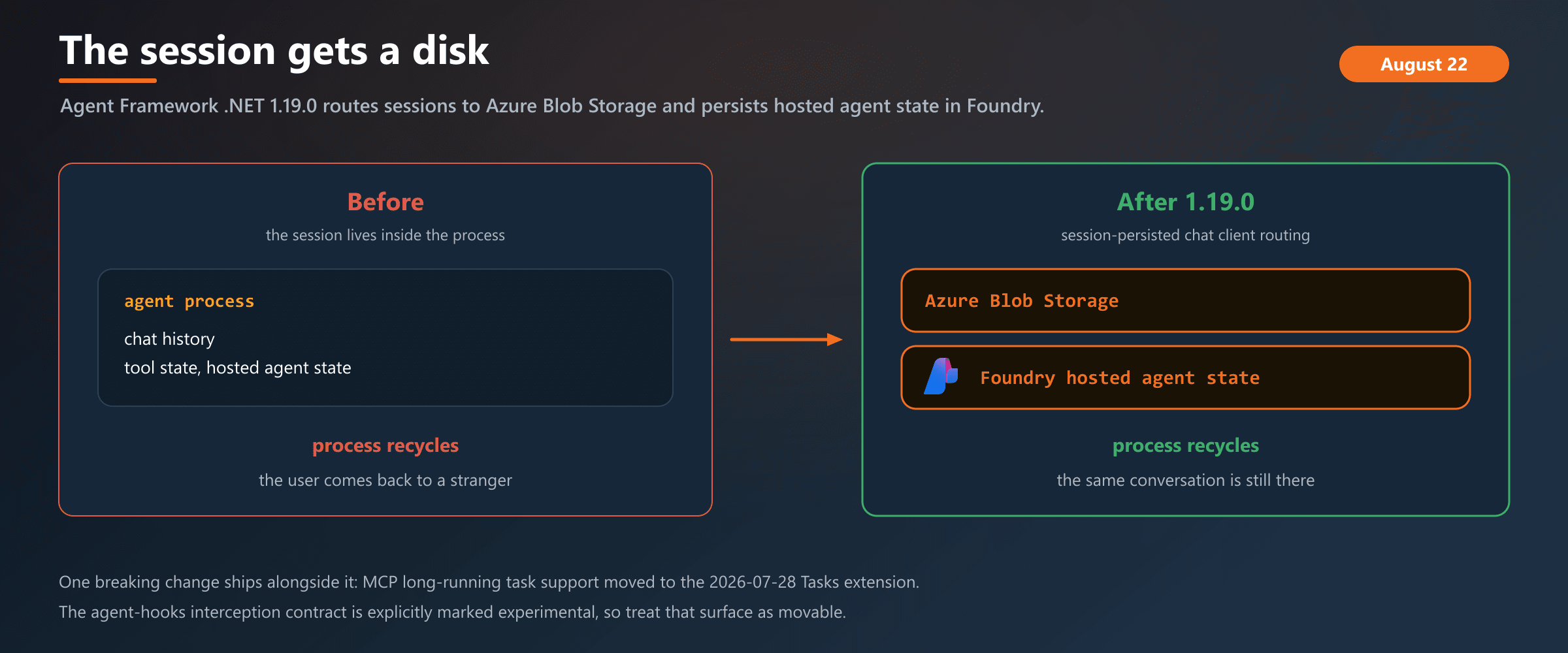
The release adds session-persisted chat client routing and an Azure Blob Storage session persistence implementation, and it persists hosted agent state in Foundry. Support for resilient long-running and steerable Foundry Hosted Agents lands alongside it, plus an agent-hooks interception contract that ships explicitly marked experimental. One breaking change is in here: MCP long-running task support migrated to the 2026-07-28 Tasks extension.
Why it matters
Every agent I have put in front of a real user eventually hits the same wall, and it is never the model. The conversation lives in a process, the process gets recycled, and the user comes back to a stranger. Until now the workaround was to hand-roll a store, so every team invented a slightly different schema and every one of them got concurrency wrong. Routing sessions to Blob Storage is unglamorous, and it is the one change here I would actually retrofit into a live project this month. Read the breaking change before you upgrade, though. The Tasks extension migration will bite anyone running long MCP calls, and the notes do not spell out the migration path as clearly as I would like.
1State stops living in the process
Three releases in four days, on three different surfaces, all solving the same problem. That is not a coincidence, it is a platform deciding where state belongs.
Agent Framework Python 1.15.0 makes middleware failures loud (August 21)
The Python release adds optional A2UI support for agent-generated interfaces, preserving streaming tool-call indices for A2UI consumers. MiddlewareFailure arrives as a first-class fatal signal for function middleware. Steering, retry and recovery come to Foundry hosted agents in the same release. One breaking change: OpenTelemetry GenAI semantic-convention support is consolidated around stable and experimental modes.
Why it matters
MiddlewareFailure is the small one that will save someone a weekend. A middleware that fails quietly is the worst class of agent bug, because the run continues, the output looks plausible, and you find out four days later from a user who assumed the answer was right. Making it fatal by default is the correct trade. As for A2UI, I have not run it against anything real yet and I would not claim to know how it behaves under load.
VS Code 1.134 detaches the agent from the window (August 19)
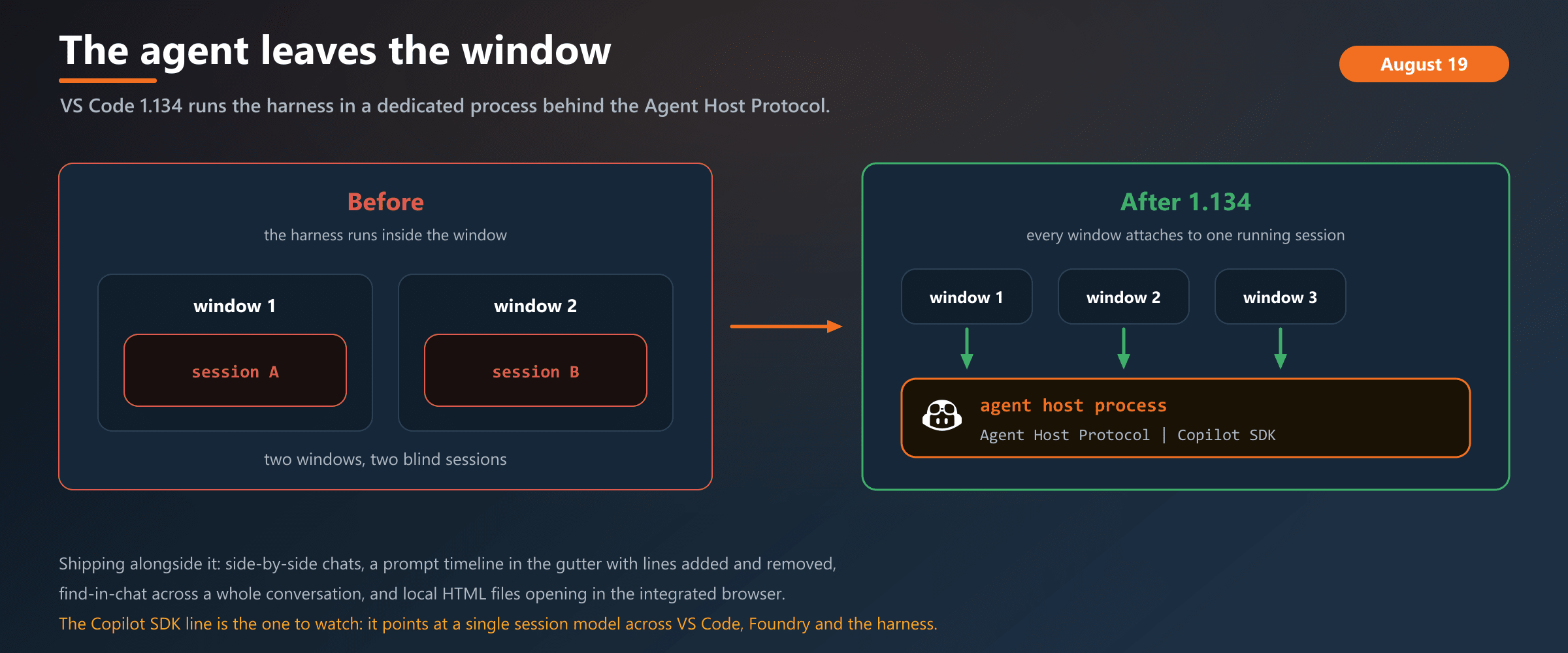
The release introduces an agent host that runs agent harnesses in a dedicated process using the Agent Host Protocol, letting you connect to the same agent session from multiple VS Code windows. That host uses the Copilot SDK to align behaviour with other Copilot products. Alongside it: side-by-side chats for comparing related conversations and subagent work, a prompt timeline in the gutter showing each prompt with lines added and removed, find-in-chat across a whole conversation, and local HTML files opening in the integrated browser by default.
Why it matters
The agent host is the same idea as the hero signal, arriving on a different surface in the same week. The Copilot SDK line is the part to watch. If VS Code, the GitHub Copilot harness in Copilot Studio and the hosted agents in Foundry all converge on one session model, then what you learn debugging one of them transfers to the others. That has never been true on this stack before, and it would quietly remove the single biggest tax on working across all three.
- QuickAgent Framework .NET 1.18.0 landed four days before 1.19.0, on August 18. If you are still on 1.17, you are taking two releases at once and one of them carries the MCP Tasks extension break.
- QuickSemantic Kernel .NET 1.80.0 shipped the same day, August 18. Semantic Kernel keeps shipping while Agent Framework absorbs the mindshare, and I still get asked which one to start a new project on. For anything new on this stack today I would start on Agent Framework.
- QuickM365 Agents Toolkit pushed templates-v4 6.15.2026082002 on August 20, a routine template refresh.
2The agent moves into the conversation
One of these puts a coding agent inside your channel history. The other changes a URL that your proxy has never heard of. Both are governance jobs this week, not next quarter.
GitHub Copilot shows up in Teams, in public preview (August 21)
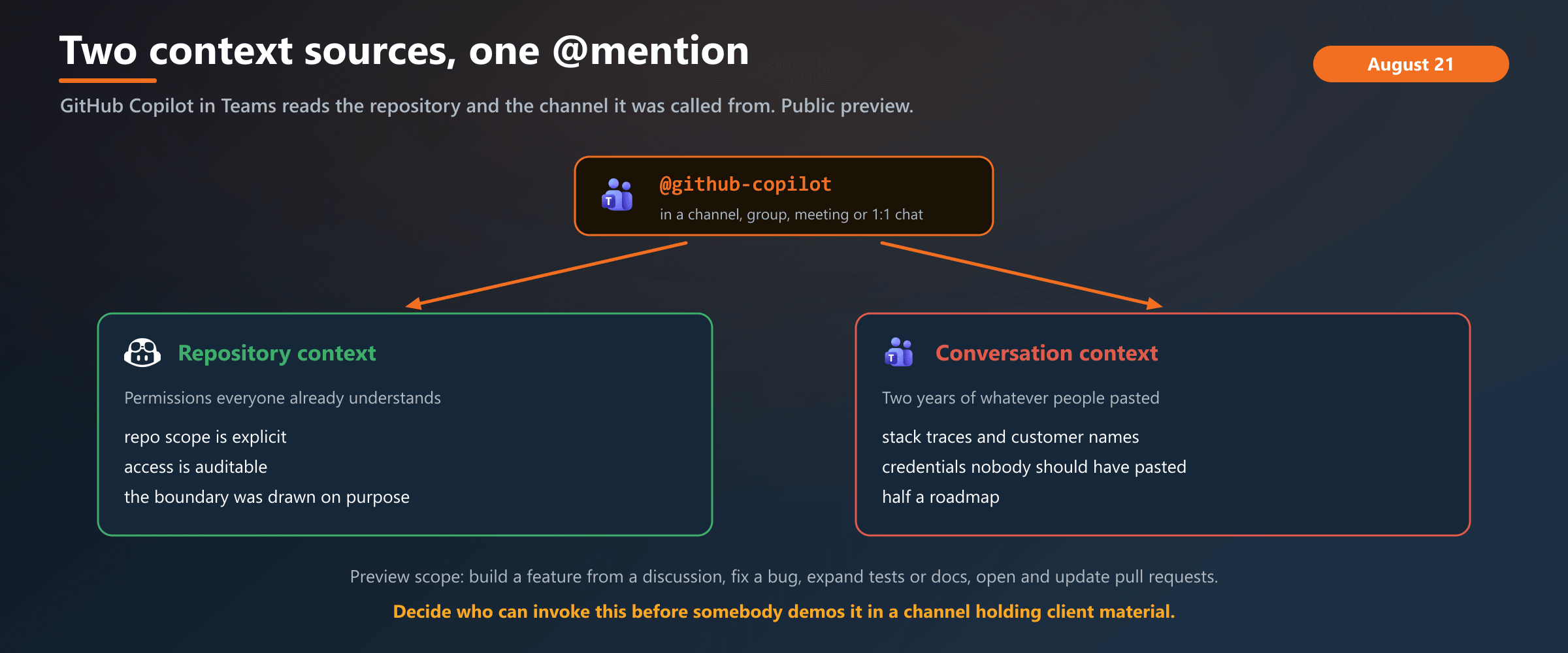
You can now @mention GitHub Copilot in Teams channels, group chats, meeting chats and 1:1 chats. Copilot combines the conversation context with repository context to act. During the preview it covers four tasks: building features from a team discussion, implementing bug fixes, expanding test coverage or documentation, and creating and updating pull requests. This is public preview, not general availability. I am being precise about that because at least one aggregator reported it as GA this week and it is not.
Why it matters
The interesting part is not that Copilot writes code from a chat. It is which chat. A Teams channel is where people paste stack traces, customer names, credentials they should not have pasted, and half a roadmap. Pointing a coding agent at that history is a real data-boundary decision, and right now it gets made in a preview-enrolment dialog by whoever clicks first. If you run governance for a tenant, decide who can invoke this before somebody demos it in a channel holding client material. That is not hypothetical for me. It is the first question I would be asked.
The Copilot app changes address (rollout began August 18)
Microsoft started rolling out an updated Copilot web, desktop and mobile experience. The web app moves from m365.cloud.microsoft to copilot.cloud.microsoft, with automatic redirection unless an organisation blocks the new URL. The app gains clearer account indicators, including a green shield for Microsoft Entra work accounts and distinct backgrounds, plus a simplified name and icon. Security, compliance and governance controls are unchanged. An early preview of the Windows and Mac desktop experience was planned for August 18, with broad deployment starting mid-September.
Why it matters
This is a URL change wearing a branding announcement as a disguise, and URL changes break tenants. Add the new host to your allow lists now, before mid-September, because the failure mode is a user who simply sees nothing load and files a ticket that lands three teams deep. I have watched a proxy rule swallow a Microsoft domain migration before. Nobody suspects the network for two days.
3The model endpoint grows a platform
Foundry spent the week turning a deployment into something you can actually build an agent on. Copilot Studio, meanwhile, shipped nothing I can point at with a date.
Five Claude capabilities arrive in Foundry (August 17)
Structured outputs, web search, web fetch, an MCP connector and tool search are now available for Claude models deployed through the hosted-on-Azure option in Foundry. The MCP connector is called out as being in beta. Haoran Cheng, a product manager on Foundry, framed the set as the building blocks that turn a model endpoint into a production agent platform.
Why it matters
Structured outputs and tool search are the two I care about, for boring reasons. Structured outputs kill the retry loop you write when a model returns prose where you wanted JSON, and I have lost more hours to that than to any genuinely hard problem. Tool search starts mattering once an agent carries more than a couple of dozen tools, because every tool definition is tokens you pay for on every turn. The beta label on the MCP connector is the line to read carefully. Beta on a connector means the contract can move, and a moving contract in the middle of your agent's tool surface is not something I would put in front of a client this quarter.
- QuickCopilot Studio had a genuinely quiet week. The what's-new page still ends at July and released-versions has not moved past the June builds, so there is nothing shipped with a date I can stand behind. The one adjacent item: Copilot Agent Kit shipped an August 2026 Update 1 on August 17, a maintenance release fixing setup for the Agent Review Tool with a guided wizard and four readiness checks. Last week I made the Kit's Agent Change Tracker the hero. The tool sitting next to it needed a patch within three days.
- QuickAgent 365 was quiet too, with no August what's-new post yet. The nearest thing, multi-tenant agent management in the Microsoft 365 admin center, went to public preview on August 10, so it belongs to the week before this one. I mention it anyway because most partners I speak to are tracking agents across customer tenants in a spreadsheet, and the risk insights there need an Agent 365 licence assigned to the end user.
4Memory becomes a record
The governance half of this week's thread, and the half I think will still matter in a year.
Purview lets you dry-run an auto-labeling policy (August)
Auto-labeling policies can now run in simulation mode before enforcement, showing which items a policy would label without changing anything. Reviewers get matched-item counts, a source breakdown across Exchange, SharePoint and OneDrive, the sensitive information types that produced matches, and sample items to inspect. A new Insights tab in the policy details panel shows policy performance, with different views depending on whether the policy is simulating or enforcing. Microsoft's own documentation is refreshingly blunt that simulation is not a completely silent dry run: it can still generate activity alerts, and matched-item counts are estimates drawn from sampling.
Why it matters
Auto-labeling is where Copilot deployments quietly go wrong. A label applied too broadly encrypts documents nobody expected. A label applied too narrowly leaves the grounding data wide open. Every CISO I brief asks a version of the same question, which is what happens on the day the policy is wrong, and simulation is how you answer that before it is a live incident instead of after. Take the estimate caveat seriously, though. Present a simulation count to a steering committee as a precise number and you will be corrected in public.
Copilot memory becomes a retention object (roadmap, planned September 2026)
Microsoft's roadmap lists retention policies becoming configurable for Microsoft 365 Copilot memory, which is stored in a hidden folder in the user's Exchange mailbox. This is a roadmap entry with a planned date, not something shipped, and roadmap dates slip.
Why it matters
Persistent agent memory is a new category of record. It sits in a mailbox, it contains inferred preferences nobody typed and nobody reviewed, and until this week nothing in the compliance stack acknowledged it existed. Whether that memory is discoverable in litigation is not a question I can answer, and I have yet to hear a lawyer answer it cleanly either. Retention controls are the first sign Microsoft intends to treat it as discoverable. If that is right, the review surface is the thing still missing, because retention tells you how long you keep an inference and nothing tells you who agreed it was correct.
5The bill lands on 1 September
Not news, and that is exactly why it is going to catch people. It was announced in June and it bites in ten days.
The GitHub Copilot credit promotion ends on August 31
GitHub moved Copilot to usage-based billing on June 1. Existing Business and Enterprise customers got a three-month promotional allowance to cushion the change: 30 dollars of monthly AI Credits for Business against a standard 19, and 70 for Enterprise against a standard 39. That promotion covers June, July and August. September invoices run at the standard amounts. In included credits that is a 37 percent reduction for Business and 44 percent for Enterprise, at an unchanged seat price. This circulated all week as though it were news. It is not. What changed is only that the deadline got close enough to matter.
Why it matters
Nobody on your team gets a warning. The seat price is identical, the included allowance falls by more than a third, and the overage surfaces on an invoice in early October addressed to someone who was not in the room when Copilot was rolled out. Pull your current credit consumption this week and compare it against the standard allowance rather than the promotional one. If you are already close to 30 dollars a user, you have a budget conversation ahead of you, and it goes much better before the invoice than after.
Voices to follow
- Microsoft Partner Director - Foundry Agent ServiceJeff Hollan
Partner Director of Product at Microsoft, leading the Foundry agent platform: Agent Service, the Agent Framework, and the SDKs. The clearest source on how agents actually go from prototype to a hosted production runtime.
Microsoft Partner Director - Foundry Agent Service + Agent Framework - Microsoft Software Engineer - CoworkBas Brekelmans
Software Engineer at Microsoft, started the Copilot Cowork project and previously CTO of Copilot Studio. The clearest voice on why Microsoft chose multi-model, MCP, and A2A architecture across the agent stack.
Microsoft Software Engineer, Cowork - ex-CTO Copilot Studio - Microsoft Principal Cloud Developer Advocate - AISeth Juarez
Principal Cloud Developer Advocate at Microsoft on AI. One of the most watchable explainers of Foundry, the Agent Framework, and GitHub Copilot for developers - deep technical content that stays accessible.
Microsoft Principal Cloud Developer Advocate - AI - Microsoft EVP - Copilot, Agents & PlatformCharles Lamanna
Executive Vice President for Copilot, Agents, and Platform at Microsoft. He owns the strategy behind Copilot Studio, Agent 365, and the Power Platform, so when the agent stack's direction shifts, it usually shifts because of a decision his org made.
Microsoft EVP - Copilot, Agents & Platform - Microsoft Principal Cloud Advocate - Power Platform + agentsDaniel Laskewitz
Principal Cloud Advocate at Microsoft, ex-Power Platform MVP and co-founder of Forward Forever. One of the clearest voices on multi-agent systems and Power Platform governance - the bridge between the maker community and the product teams.
Microsoft Principal Cloud Advocate - Power Platform governance + agents - Copilot Studio MVPLisa Crosbie
6x Microsoft MVP, Practical AI for Business with Copilot and Agents at Barhead. Calm, hands-on voice on production-grade agent design - the one to follow when you want patterns you can ship, not just demo.
6x Microsoft MVP - YouTuber + International Speaker - ~21K followers - Microsoft VP - Product, Microsoft FoundryYina Arenas
Vice President of Product for Microsoft Foundry. She owns the developer surface where hosted agents, the agent catalogue and the Foundry tooling story get decided, and she posts the roadmap thinking behind them.
Microsoft VP - Product, Microsoft Foundry - Microsoft VP - Azure AI FoundryMarco Casalaina
VP at Microsoft focused on Azure AI Foundry and the Foundry Agent Service. A direct source on frontier models, hosted agents, and the runtime developers build production agents on.
Microsoft VP - Azure AI Foundry Agent Service
Coming up
- August 31, 2026 · GitHub Copilot promotional AI Credit allowances end for Business and Enterprise. September usage bills at the standard 19 and 39 dollars per user. Check consumption before the invoice, not after.
- August 31, 2026 · Entries close for the CSP Copilot Partner Council contest. Needs evidence of at least 25 Microsoft 365 Copilot seats. Twenty winners get a seat on the council.
- September 1, 2026 · Updated Microsoft AI Cloud Partner Program agreement terms take effect. Automatic, no signature or acknowledgement required, which is precisely why nobody reads it.
- September 3, 2026 · Windows 365 Frontline SKUs become Windows 365 Flex. Branding only, with no change to entitlements. Update any script, report or runbook that matches on the old name.
- Mid-September 2026 · Broad deployment of the updated Copilot desktop app begins. Confirm copilot.cloud.microsoft is not blocked by proxy, firewall or access policy first.
- October 1, 2026 · A 5 percent cost of capital uplift applies to annual-term CSP software subscriptions billed monthly. Applies at renewal on or after that date. Annual billing and month-to-month are unaffected.
This week's question
If an agent's memory lives in a hidden folder in a user's mailbox, and it holds preferences the user never typed and never reviewed, who is accountable when it is wrong? I lean towards the tenant, the same way the tenant owns any other mailbox content, and that reading makes Purview retention controls the right response. But I am not sure it survives contact with a real dispute. A retention policy tells you how long something is kept. It says nothing about who agreed the inference was correct, and there is no review surface for that at all today. My guess is we find out through a discovery request rather than through documentation.
Get Agentic Weekly in your inbox
Every Monday morning. Unsubscribe any time.